
new
Get trending papers in your email inbox once a day!
Get trending papers in your email inbox!
Subscribe
Event-based Temporally Dense Optical Flow Estimation with Sequential Neural Networks
Prior works on event-based optical flow estimation have investigated several gradient-based learning methods to train neural networks for predicting optical flow. However, they do not utilize the fast data rate of event data streams and rely on a spatio-temporal representation constructed from a collection of events over a fixed period of time (often between two grayscale frames). As a result, optical flow is only evaluated at a frequency much lower than the rate data is produced by an event-based camera, leading to a temporally sparse optical flow estimation. To predict temporally dense optical flow, we cast the problem as a sequential learning task and propose a training methodology to train sequential networks for continuous prediction on an event stream. We propose two types of networks: one focused on performance and another focused on compute efficiency. We first train long-short term memory networks (LSTMs) on the DSEC dataset and demonstrated 10x temporally dense optical flow estimation over existing flow estimation approaches. The additional benefit of having a memory to draw long temporal correlations back in time results in a 19.7% improvement in flow prediction accuracy of LSTMs over similar networks with no memory elements. We subsequently show that the inherent recurrence of spiking neural networks (SNNs) enables them to learn and estimate temporally dense optical flow with 31.8% lesser parameters than LSTM, but with a slightly increased error. This demonstrates potential for energy-efficient implementation of fast optical flow prediction using SNNs.
ML-SIM: A deep neural network for reconstruction of structured illumination microscopy images
Structured illumination microscopy (SIM) has become an important technique for optical super-resolution imaging because it allows a doubling of image resolution at speeds compatible for live-cell imaging. However, the reconstruction of SIM images is often slow and prone to artefacts. Here we propose a versatile reconstruction method, ML-SIM, which makes use of machine learning. The model is an end-to-end deep residual neural network that is trained on a simulated data set to be free of common SIM artefacts. ML-SIM is thus robust to noise and irregularities in the illumination patterns of the raw SIM input frames. The reconstruction method is widely applicable and does not require the acquisition of experimental training data. Since the training data are generated from simulations of the SIM process on images from generic libraries the method can be efficiently adapted to specific experimental SIM implementations. The reconstruction quality enabled by our method is compared with traditional SIM reconstruction methods, and we demonstrate advantages in terms of noise, reconstruction fidelity and contrast for both simulated and experimental inputs. In addition, reconstruction of one SIM frame typically only takes ~100ms to perform on PCs with modern Nvidia graphics cards, making the technique compatible with real-time imaging. The full implementation and the trained networks are available at http://ML-SIM.com.
Rapid Network Adaptation: Learning to Adapt Neural Networks Using Test-Time Feedback
We propose a method for adapting neural networks to distribution shifts at test-time. In contrast to training-time robustness mechanisms that attempt to anticipate and counter the shift, we create a closed-loop system and make use of a test-time feedback signal to adapt a network on the fly. We show that this loop can be effectively implemented using a learning-based function, which realizes an amortized optimizer for the network. This leads to an adaptation method, named Rapid Network Adaptation (RNA), that is notably more flexible and orders of magnitude faster than the baselines. Through a broad set of experiments using various adaptation signals and target tasks, we study the efficiency and flexibility of this method. We perform the evaluations using various datasets (Taskonomy, Replica, ScanNet, Hypersim, COCO, ImageNet), tasks (depth, optical flow, semantic segmentation, classification), and distribution shifts (Cross-datasets, 2D and 3D Common Corruptions) with promising results. We end with a discussion on general formulations for handling distribution shifts and our observations from comparing with similar approaches from other domains.
Light-in-the-loop: using a photonics co-processor for scalable training of neural networks
As neural networks grow larger and more complex and data-hungry, training costs are skyrocketing. Especially when lifelong learning is necessary, such as in recommender systems or self-driving cars, this might soon become unsustainable. In this study, we present the first optical co-processor able to accelerate the training phase of digitally-implemented neural networks. We rely on direct feedback alignment as an alternative to backpropagation, and perform the error projection step optically. Leveraging the optical random projections delivered by our co-processor, we demonstrate its use to train a neural network for handwritten digits recognition.

Low-Latency Human Action Recognition with Weighted Multi-Region Convolutional Neural Network
Spatio-temporal contexts are crucial in understanding human actions in videos. Recent state-of-the-art Convolutional Neural Network (ConvNet) based action recognition systems frequently involve 3D spatio-temporal ConvNet filters, chunking videos into fixed length clips and Long Short Term Memory (LSTM) networks. Such architectures are designed to take advantage of both short term and long term temporal contexts, but also requires the accumulation of a predefined number of video frames (e.g., to construct video clips for 3D ConvNet filters, to generate enough inputs for LSTMs). For applications that require low-latency online predictions of fast-changing action scenes, a new action recognition system is proposed in this paper. Termed "Weighted Multi-Region Convolutional Neural Network" (WMR ConvNet), the proposed system is LSTM-free, and is based on 2D ConvNet that does not require the accumulation of video frames for 3D ConvNet filtering. Unlike early 2D ConvNets that are based purely on RGB frames and optical flow frames, the WMR ConvNet is designed to simultaneously capture multiple spatial and short term temporal cues (e.g., human poses, occurrences of objects in the background) with both the primary region (foreground) and secondary regions (mostly background). On both the UCF101 and HMDB51 datasets, the proposed WMR ConvNet achieves the state-of-the-art performance among competing low-latency algorithms. Furthermore, WMR ConvNet even outperforms the 3D ConvNet based C3D algorithm that requires video frame accumulation. In an ablation study with the optical flow ConvNet stream removed, the ablated WMR ConvNet nevertheless outperforms competing algorithms.
Plug-in, Trainable Gate for Streamlining Arbitrary Neural Networks
Architecture optimization, which is a technique for finding an efficient neural network that meets certain requirements, generally reduces to a set of multiple-choice selection problems among alternative sub-structures or parameters. The discrete nature of the selection problem, however, makes this optimization difficult. To tackle this problem we introduce a novel concept of a trainable gate function. The trainable gate function, which confers a differentiable property to discretevalued variables, allows us to directly optimize loss functions that include non-differentiable discrete values such as 0-1 selection. The proposed trainable gate can be applied to pruning. Pruning can be carried out simply by appending the proposed trainable gate functions to each intermediate output tensor followed by fine-tuning the overall model, using any gradient-based training methods. So the proposed method can jointly optimize the selection of the pruned channels while fine-tuning the weights of the pruned model at the same time. Our experimental results demonstrate that the proposed method efficiently optimizes arbitrary neural networks in various tasks such as image classification, style transfer, optical flow estimation, and neural machine translation.

IndraEye: Infrared Electro-Optical UAV-based Perception Dataset for Robust Downstream Tasks
Deep neural networks (DNNs) have shown exceptional performance when trained on well-illuminated images captured by Electro-Optical (EO) cameras, which provide rich texture details. However, in critical applications like aerial perception, it is essential for DNNs to maintain consistent reliability across all conditions, including low-light scenarios where EO cameras often struggle to capture sufficient detail. Additionally, UAV-based aerial object detection faces significant challenges due to scale variability from varying altitudes and slant angles, adding another layer of complexity. Existing methods typically address only illumination changes or style variations as domain shifts, but in aerial perception, correlation shifts also impact DNN performance. In this paper, we introduce the IndraEye dataset, a multi-sensor (EO-IR) dataset designed for various tasks. It includes 5,612 images with 145,666 instances, encompassing multiple viewing angles, altitudes, seven backgrounds, and different times of the day across the Indian subcontinent. The dataset opens up several research opportunities, such as multimodal learning, domain adaptation for object detection and segmentation, and exploration of sensor-specific strengths and weaknesses. IndraEye aims to advance the field by supporting the development of more robust and accurate aerial perception systems, particularly in challenging conditions. IndraEye dataset is benchmarked with object detection and semantic segmentation tasks. Dataset and source codes are available at https://bit.ly/indraeye.
NeRF2: Neural Radio-Frequency Radiance Fields
Although Maxwell discovered the physical laws of electromagnetic waves 160 years ago, how to precisely model the propagation of an RF signal in an electrically large and complex environment remains a long-standing problem. The difficulty is in the complex interactions between the RF signal and the obstacles (e.g., reflection, diffraction, etc.). Inspired by the great success of using a neural network to describe the optical field in computer vision, we propose a neural radio-frequency radiance field, NeRF^2, which represents a continuous volumetric scene function that makes sense of an RF signal's propagation. Particularly, after training with a few signal measurements, NeRF^2 can tell how/what signal is received at any position when it knows the position of a transmitter. As a physical-layer neural network, NeRF^2 can take advantage of the learned statistic model plus the physical model of ray tracing to generate a synthetic dataset that meets the training demands of application-layer artificial neural networks (ANNs). Thus, we can boost the performance of ANNs by the proposed turbo-learning, which mixes the true and synthetic datasets to intensify the training. Our experiment results show that turbo-learning can enhance performance with an approximate 50% increase. We also demonstrate the power of NeRF^2 in the field of indoor localization and 5G MIMO.
A Hybrid CNN-LSTM model for Video Deepfake Detection by Leveraging Optical Flow Features
Deepfakes are the synthesized digital media in order to create ultra-realistic fake videos to trick the spectator. Deep generative algorithms, such as, Generative Adversarial Networks(GAN) are widely used to accomplish such tasks. This approach synthesizes pseudo-realistic contents that are very difficult to distinguish by traditional detection methods. In most cases, Convolutional Neural Network(CNN) based discriminators are being used for detecting such synthesized media. However, it emphasise primarily on the spatial attributes of individual video frames, thereby fail to learn the temporal information from their inter-frame relations. In this paper, we leveraged an optical flow based feature extraction approach to extract the temporal features, which are then fed to a hybrid model for classification. This hybrid model is based on the combination of CNN and recurrent neural network (RNN) architectures. The hybrid model provides effective performance on open source data-sets such as, DFDC, FF++ and Celeb-DF. This proposed method shows an accuracy of 66.26%, 91.21% and 79.49% in DFDC, FF++, and Celeb-DF respectively with a very reduced No of sample size of approx 100 samples(frames). This promises early detection of fake contents compared to existing modalities.
DeepOIS: Gyroscope-Guided Deep Optical Image Stabilizer Compensation
Mobile captured images can be aligned using their gyroscope sensors. Optical image stabilizer (OIS) terminates this possibility by adjusting the images during the capturing. In this work, we propose a deep network that compensates the motions caused by the OIS, such that the gyroscopes can be used for image alignment on the OIS cameras. To achieve this, first, we record both videos and gyroscopes with an OIS camera as training data. Then, we convert gyroscope readings into motion fields. Second, we propose a Fundamental Mixtures motion model for rolling shutter cameras, where an array of rotations within a frame are extracted as the ground-truth guidance. Third, we train a convolutional neural network with gyroscope motions as input to compensate for the OIS motion. Once finished, the compensation network can be applied for other scenes, where the image alignment is purely based on gyroscopes with no need for images contents, delivering strong robustness. Experiments show that our results are comparable with that of non-OIS cameras, and outperform image-based alignment results with a relatively large margin. Code and dataset are available at https://github.com/lhaippp/DeepOIS
CompactFlowNet: Efficient Real-time Optical Flow Estimation on Mobile Devices
We present CompactFlowNet, the first real-time mobile neural network for optical flow prediction, which involves determining the displacement of each pixel in an initial frame relative to the corresponding pixel in a subsequent frame. Optical flow serves as a fundamental building block for various video-related tasks, such as video restoration, motion estimation, video stabilization, object tracking, action recognition, and video generation. While current state-of-the-art methods prioritize accuracy, they often overlook constraints regarding speed and memory usage. Existing light models typically focus on reducing size but still exhibit high latency, compromise significantly on quality, or are optimized for high-performance GPUs, resulting in sub-optimal performance on mobile devices. This study aims to develop a mobile-optimized optical flow model by proposing a novel mobile device-compatible architecture, as well as enhancements to the training pipeline, which optimize the model for reduced weight, low memory utilization, and increased speed while maintaining minimal error. Our approach demonstrates superior or comparable performance to the state-of-the-art lightweight models on the challenging KITTI and Sintel benchmarks. Furthermore, it attains a significantly accelerated inference speed, thereby yielding real-time operational efficiency on the iPhone 8, while surpassing real-time performance levels on more advanced mobile devices.



IllusionVQA: A Challenging Optical Illusion Dataset for Vision Language Models
The advent of Vision Language Models (VLM) has allowed researchers to investigate the visual understanding of a neural network using natural language. Beyond object classification and detection, VLMs are capable of visual comprehension and common-sense reasoning. This naturally led to the question: How do VLMs respond when the image itself is inherently unreasonable? To this end, we present IllusionVQA: a diverse dataset of challenging optical illusions and hard-to-interpret scenes to test the capability of VLMs in two distinct multiple-choice VQA tasks - comprehension and soft localization. GPT4V, the best-performing VLM, achieves 62.99% accuracy (4-shot) on the comprehension task and 49.7% on the localization task (4-shot and Chain-of-Thought). Human evaluation reveals that humans achieve 91.03% and 100% accuracy in comprehension and localization. We discover that In-Context Learning (ICL) and Chain-of-Thought reasoning substantially degrade the performance of GeminiPro on the localization task. Tangentially, we discover a potential weakness in the ICL capabilities of VLMs: they fail to locate optical illusions even when the correct answer is in the context window as a few-shot example.


OmniFlow: Human Omnidirectional Optical Flow
Optical flow is the motion of a pixel between at least two consecutive video frames and can be estimated through an end-to-end trainable convolutional neural network. To this end, large training datasets are required to improve the accuracy of optical flow estimation. Our paper presents OmniFlow: a new synthetic omnidirectional human optical flow dataset. Based on a rendering engine we create a naturalistic 3D indoor environment with textured rooms, characters, actions, objects, illumination and motion blur where all components of the environment are shuffled during the data capturing process. The simulation has as output rendered images of household activities and the corresponding forward and backward optical flow. To verify the data for training volumetric correspondence networks for optical flow estimation we train different subsets of the data and test on OmniFlow with and without Test-Time-Augmentation. As a result we have generated 23,653 image pairs and corresponding forward and backward optical flow. Our dataset can be downloaded from: https://mytuc.org/byfs
AppleCiDEr II: SpectraNet -- A Deep Learning Network for Spectroscopic Data
Time-domain surveys such as the Zwicky Transient Facility (ZTF) have opened a new frontier in the discovery and characterization of transients. While photometric light curves provide broad temporal coverage, spectroscopic observations remain crucial for physical interpretation and source classification. However, existing spectral analysis methods -- often reliant on template fitting or parametric models -- are limited in their ability to capture the complex and evolving spectra characteristic of such sources, which are sometimes only available at low resolution. In this work, we introduce SpectraNet, a deep convolutional neural network designed to learn robust representations of optical spectra from transients. Our model combines multi-scale convolution kernels and multi-scale pooling to extract features from preprocessed spectra in a hierarchical and interpretable manner. We train and validate SpectraNet on low-resolution time-series spectra obtained from the Spectral Energy Distribution Machine (SEDM) and other instruments, demonstrating state-of-the-art performance in classification. Furthermore, in redshift prediction tasks, SpectraNet achieves a root mean squared relative redshift error of 0.02, highlighting its effectiveness in precise regression tasks as well.
Deep Structured Feature Networks for Table Detection and Tabular Data Extraction from Scanned Financial Document Images
Automatic table detection in PDF documents has achieved a great success but tabular data extraction are still challenging due to the integrity and noise issues in detected table areas. The accurate data extraction is extremely crucial in finance area. Inspired by this, the aim of this research is proposing an automated table detection and tabular data extraction from financial PDF documents. We proposed a method that consists of three main processes, which are detecting table areas with a Faster R-CNN (Region-based Convolutional Neural Network) model with Feature Pyramid Network (FPN) on each page image, extracting contents and structures by a compounded layout segmentation technique based on optical character recognition (OCR) and formulating regular expression rules for table header separation. The tabular data extraction feature is embedded with rule-based filtering and restructuring functions that are highly scalable. We annotate a new Financial Documents dataset with table regions for the experiment. The excellent table detection performance of the detection model is obtained from our customized dataset. The main contributions of this paper are proposing the Financial Documents dataset with table-area annotations, the superior detection model and the rule-based layout segmentation technique for the tabular data extraction from PDF files.
PsOCR: Benchmarking Large Multimodal Models for Optical Character Recognition in Low-resource Pashto Language
This paper evaluates the performance of Large Multimodal Models (LMMs) on Optical Character Recognition (OCR) in the low-resource Pashto language. Natural Language Processing (NLP) in Pashto faces several challenges due to the cursive nature of its script and a scarcity of structured datasets. To address this, we developed a synthetic Pashto OCR dataset, PsOCR, consisting of one million images annotated with bounding boxes at word, line, and document levels, suitable for training and evaluating models based on different architectures, including Convolutional Neural Networks (CNNs) and Transformers. PsOCR covers variations across 1,000 unique font families, colors, image sizes, and layouts. A benchmark subset of 10K images was selected to evaluate the performance of several LMMs, including seven open-source models: DeepSeek's Janus, InternVL, MiniCPM, Florence, and Qwen (3B and 7B), and four closed-source models: GPT-4o, Gemini, Claude, and Grok. Experimental results demonstrate that Gemini achieves the best performance among all models, whereas among open-source models, Qwen-7B stands out. This work provides an insightful assessment of the capabilities and limitations of current LMMs for OCR tasks in Pashto and establishes a foundation for further research not only in Pashto OCR but also for other similar scripts such as Arabic, Persian, and Urdu. PsOCR is available at https://github.com/zirak-ai/PashtoOCR.

Recursive Recurrent Nets with Attention Modeling for OCR in the Wild
We present recursive recurrent neural networks with attention modeling (R^2AM) for lexicon-free optical character recognition in natural scene images. The primary advantages of the proposed method are: (1) use of recursive convolutional neural networks (CNNs), which allow for parametrically efficient and effective image feature extraction; (2) an implicitly learned character-level language model, embodied in a recurrent neural network which avoids the need to use N-grams; and (3) the use of a soft-attention mechanism, allowing the model to selectively exploit image features in a coordinated way, and allowing for end-to-end training within a standard backpropagation framework. We validate our method with state-of-the-art performance on challenging benchmark datasets: Street View Text, IIIT5k, ICDAR and Synth90k.

Dense Road Surface Grip Map Prediction from Multimodal Image Data
Slippery road weather conditions are prevalent in many regions and cause a regular risk for traffic. Still, there has been less research on how autonomous vehicles could detect slippery driving conditions on the road to drive safely. In this work, we propose a method to predict a dense grip map from the area in front of the car, based on postprocessed multimodal sensor data. We trained a convolutional neural network to predict pixelwise grip values from fused RGB camera, thermal camera, and LiDAR reflectance images, based on weakly supervised ground truth from an optical road weather sensor. The experiments show that it is possible to predict dense grip values with good accuracy from the used data modalities as the produced grip map follows both ground truth measurements and local weather conditions, such as snowy areas on the road. The model using only the RGB camera or LiDAR reflectance modality provided good baseline results for grip prediction accuracy while using models fusing the RGB camera, thermal camera, and LiDAR modalities improved the grip predictions significantly.

ReynoldsFlow: Exquisite Flow Estimation via Reynolds Transport Theorem
Optical flow is a fundamental technique for motion estimation, widely applied in video stabilization, interpolation, and object tracking. Traditional optical flow estimation methods rely on restrictive assumptions like brightness constancy and slow motion constraints. Recent deep learning-based flow estimations require extensive training on large domain-specific datasets, making them computationally demanding. Also, artificial intelligence (AI) advances have enabled deep learning models to take advantage of optical flow as an important feature for object tracking and motion analysis. Since optical flow is commonly encoded in HSV for visualization, its conversion to RGB for neural network processing is nonlinear and may introduce perceptual distortions. These transformations amplify the sensitivity to estimation errors, potentially affecting the predictive accuracy of the networks. To address these challenges that are influential to the performance of downstream network models, we propose Reynolds flow, a novel training-free flow estimation inspired by the Reynolds transport theorem, offering a principled approach to modeling complex motion dynamics. In addition to conventional HSV-based visualization of Reynolds flow, we also introduce an RGB-encoded representation of Reynolds flow designed to improve flow visualization and feature enhancement for neural networks. We evaluated the effectiveness of Reynolds flow in video-based tasks. Experimental results on three benchmarks, tiny object detection on UAVDB, infrared object detection on Anti-UAV, and pose estimation on GolfDB, demonstrate that networks trained with RGB-encoded Reynolds flow achieve SOTA performance, exhibiting improved robustness and efficiency across all tasks.

Photonic Differential Privacy with Direct Feedback Alignment
Optical Processing Units (OPUs) -- low-power photonic chips dedicated to large scale random projections -- have been used in previous work to train deep neural networks using Direct Feedback Alignment (DFA), an effective alternative to backpropagation. Here, we demonstrate how to leverage the intrinsic noise of optical random projections to build a differentially private DFA mechanism, making OPUs a solution of choice to provide a private-by-design training. We provide a theoretical analysis of our adaptive privacy mechanism, carefully measuring how the noise of optical random projections propagates in the process and gives rise to provable Differential Privacy. Finally, we conduct experiments demonstrating the ability of our learning procedure to achieve solid end-task performance.

Internal Video Inpainting by Implicit Long-range Propagation
We propose a novel framework for video inpainting by adopting an internal learning strategy. Unlike previous methods that use optical flow for cross-frame context propagation to inpaint unknown regions, we show that this can be achieved implicitly by fitting a convolutional neural network to known regions. Moreover, to handle challenging sequences with ambiguous backgrounds or long-term occlusion, we design two regularization terms to preserve high-frequency details and long-term temporal consistency. Extensive experiments on the DAVIS dataset demonstrate that the proposed method achieves state-of-the-art inpainting quality quantitatively and qualitatively. We further extend the proposed method to another challenging task: learning to remove an object from a video giving a single object mask in only one frame in a 4K video.
Precipitation Nowcasting with Satellite Imagery
Precipitation nowcasting is a short-range forecast of rain/snow (up to 2 hours), often displayed on top of the geographical map by the weather service. Modern precipitation nowcasting algorithms rely on the extrapolation of observations by ground-based radars via optical flow techniques or neural network models. Dependent on these radars, typical nowcasting is limited to the regions around their locations. We have developed a method for precipitation nowcasting based on geostationary satellite imagery and incorporated the resulting data into the Yandex.Weather precipitation map (including an alerting service with push notifications for products in the Yandex ecosystem), thus expanding its coverage and paving the way to a truly global nowcasting service.

Read My Ears! Horse Ear Movement Detection for Equine Affective State Assessment
The Equine Facial Action Coding System (EquiFACS) enables the systematic annotation of facial movements through distinct Action Units (AUs). It serves as a crucial tool for assessing affective states in horses by identifying subtle facial expressions associated with discomfort. However, the field of horse affective state assessment is constrained by the scarcity of annotated data, as manually labelling facial AUs is both time-consuming and costly. To address this challenge, automated annotation systems are essential for leveraging existing datasets and improving affective states detection tools. In this work, we study different methods for specific ear AU detection and localization from horse videos. We leverage past works on deep learning-based video feature extraction combined with recurrent neural networks for the video classification task, as well as a classic optical flow based approach. We achieve 87.5% classification accuracy of ear movement presence on a public horse video dataset, demonstrating the potential of our approach. We discuss future directions to develop these systems, with the aim of bridging the gap between automated AU detection and practical applications in equine welfare and veterinary diagnostics. Our code will be made publicly available at https://github.com/jmalves5/read-my-ears.
Generalizable Implicit Motion Modeling for Video Frame Interpolation
Motion modeling is critical in flow-based Video Frame Interpolation (VFI). Existing paradigms either consider linear combinations of bidirectional flows or directly predict bilateral flows for given timestamps without exploring favorable motion priors, thus lacking the capability of effectively modeling spatiotemporal dynamics in real-world videos. To address this limitation, in this study, we introduce Generalizable Implicit Motion Modeling (GIMM), a novel and effective approach to motion modeling for VFI. Specifically, to enable GIMM as an effective motion modeling paradigm, we design a motion encoding pipeline to model spatiotemporal motion latent from bidirectional flows extracted from pre-trained flow estimators, effectively representing input-specific motion priors. Then, we implicitly predict arbitrary-timestep optical flows within two adjacent input frames via an adaptive coordinate-based neural network, with spatiotemporal coordinates and motion latent as inputs. Our GIMM can be smoothly integrated with existing flow-based VFI works without further modifications. We show that GIMM performs better than the current state of the art on the VFI benchmarks.

Multimodal Deep Models for Predicting Affective Responses Evoked by Movies
The goal of this study is to develop and analyze multimodal models for predicting experienced affective responses of viewers watching movie clips. We develop hybrid multimodal prediction models based on both the video and audio of the clips. For the video content, we hypothesize that both image content and motion are crucial features for evoked emotion prediction. To capture such information, we extract features from RGB frames and optical flow using pre-trained neural networks. For the audio model, we compute an enhanced set of low-level descriptors including intensity, loudness, cepstrum, linear predictor coefficients, pitch and voice quality. Both visual and audio features are then concatenated to create audio-visual features, which are used to predict the evoked emotion. To classify the movie clips into the corresponding affective response categories, we propose two approaches based on deep neural network models. The first one is based on fully connected layers without memory on the time component, the second incorporates the sequential dependency with a long short-term memory recurrent neural network (LSTM). We perform a thorough analysis of the importance of each feature set. Our experiments reveal that in our set-up, predicting emotions at each time step independently gives slightly better accuracy performance than with the LSTM. Interestingly, we also observe that the optical flow is more informative than the RGB in videos, and overall, models using audio features are more accurate than those based on video features when making the final prediction of evoked emotions.

Baybayin Character Instance Detection
The Philippine Government recently passed the "National Writing System Act," which promotes using Baybayin in Philippine texts. In support of this effort to promote the use of Baybayin, we present a computer vision system which can aid individuals who cannot easily read Baybayin script. In this paper, we survey the existing methods of identifying Baybayin scripts using computer vision and machine learning techniques and discuss their capabilities and limitations. Further, we propose a Baybayin Optical Character Instance Segmentation and Classification model using state-of-the-art Convolutional Neural Networks (CNNs) that detect Baybayin character instances in an image then outputs the Latin alphabet counterparts of each character instance in the image. Most existing systems are limited to character-level image classification and often misclassify or not natively support characters with diacritics. In addition, these existing models often have specific input requirements that limit it to classifying Baybayin text in a controlled setting, such as limitations in clarity and contrast, among others. To our knowledge, our proposed method is the first end-to-end character instance detection model for Baybayin, achieving a mAP50 score of 93.30%, mAP50-95 score of 80.50%, and F1-Score of 84.84%.
BF-STVSR: B-Splines and Fourier-Best Friends for High Fidelity Spatial-Temporal Video Super-Resolution
Enhancing low-resolution, low-frame-rate videos to high-resolution, high-frame-rate quality is essential for a seamless user experience, motivating advancements in Continuous Spatial-Temporal Video Super Resolution (C-STVSR). While prior methods employ Implicit Neural Representation (INR) for continuous encoding, they often struggle to capture the complexity of video data, relying on simple coordinate concatenation and pre-trained optical flow network for motion representation. Interestingly, we find that adding position encoding, contrary to common observations, does not improve-and even degrade performance. This issue becomes particularly pronounced when combined with pre-trained optical flow networks, which can limit the model's flexibility. To address these issues, we propose BF-STVSR, a C-STVSR framework with two key modules tailored to better represent spatial and temporal characteristics of video: 1) B-spline Mapper for smooth temporal interpolation, and 2) Fourier Mapper for capturing dominant spatial frequencies. Our approach achieves state-of-the-art PSNR and SSIM performance, showing enhanced spatial details and natural temporal consistency.
Efficient Deep Neural Networks
The success of deep neural networks (DNNs) is attributable to three factors: increased compute capacity, more complex models, and more data. These factors, however, are not always present, especially for edge applications such as autonomous driving, augmented reality, and internet-of-things. Training DNNs requires a large amount of data, which is difficult to obtain. Edge devices such as mobile phones have limited compute capacity, and therefore, require specialized and efficient DNNs. However, due to the enormous design space and prohibitive training costs, designing efficient DNNs for different target devices is challenging. So the question is, with limited data, compute capacity, and model complexity, can we still successfully apply deep neural networks? This dissertation focuses on the above problems and improving the efficiency of deep neural networks at four levels. Model efficiency: we designed neural networks for various computer vision tasks and achieved more than 10x faster speed and lower energy. Data efficiency: we developed an advanced tool that enables 6.2x faster annotation of a LiDAR point cloud. We also leveraged domain adaptation to utilize simulated data, bypassing the need for real data. Hardware efficiency: we co-designed neural networks and hardware accelerators and achieved 11.6x faster inference. Design efficiency: the process of finding the optimal neural networks is time-consuming. Our automated neural architecture search algorithms discovered, using 421x lower computational cost than previous search methods, models with state-of-the-art accuracy and efficiency.
Hessian-Aware Pruning and Optimal Neural Implant
Pruning is an effective method to reduce the memory footprint and FLOPs associated with neural network models. However, existing structured-pruning methods often result in significant accuracy degradation for moderate pruning levels. To address this problem, we introduce a new Hessian Aware Pruning (HAP) method coupled with a Neural Implant approach that uses second-order sensitivity as a metric for structured pruning. The basic idea is to prune insensitive components and to use a Neural Implant for moderately sensitive components, instead of completely pruning them. For the latter approach, the moderately sensitive components are replaced with with a low rank implant that is smaller and less computationally expensive than the original component. We use the relative Hessian trace to measure sensitivity, as opposed to the magnitude based sensitivity metric commonly used in the literature. We test HAP for both computer vision tasks and natural language tasks, and we achieve new state-of-the-art results. Specifically, HAP achieves less than 0.1%/0.5% degradation on PreResNet29/ResNet50 (CIFAR-10/ImageNet) with more than 70\%/50\% of parameters pruned. Meanwhile, HAP also achieves significantly better performance (up to 0.8\% with 60\% of parameters pruned) as compared to gradient based method for head pruning on transformer-based models. The framework has been open sourced and available online.



Building Optimal Neural Architectures using Interpretable Knowledge
Neural Architecture Search is a costly practice. The fact that a search space can span a vast number of design choices with each architecture evaluation taking nontrivial overhead makes it hard for an algorithm to sufficiently explore candidate networks. In this paper, we propose AutoBuild, a scheme which learns to align the latent embeddings of operations and architecture modules with the ground-truth performance of the architectures they appear in. By doing so, AutoBuild is capable of assigning interpretable importance scores to architecture modules, such as individual operation features and larger macro operation sequences such that high-performance neural networks can be constructed without any need for search. Through experiments performed on state-of-the-art image classification, segmentation, and Stable Diffusion models, we show that by mining a relatively small set of evaluated architectures, AutoBuild can learn to build high-quality architectures directly or help to reduce search space to focus on relevant areas, finding better architectures that outperform both the original labeled ones and ones found by search baselines. Code available at https://github.com/Ascend-Research/AutoBuild

SWAT-NN: Simultaneous Weights and Architecture Training for Neural Networks in a Latent Space
Designing neural networks typically relies on manual trial and error or a neural architecture search (NAS) followed by weight training. The former is time-consuming and labor-intensive, while the latter often discretizes architecture search and weight optimization. In this paper, we propose a fundamentally different approach that simultaneously optimizes both the architecture and the weights of a neural network. Our framework first trains a universal multi-scale autoencoder that embeds both architectural and parametric information into a continuous latent space, where functionally similar neural networks are mapped closer together. Given a dataset, we then randomly initialize a point in the embedding space and update it via gradient descent to obtain the optimal neural network, jointly optimizing its structure and weights. The optimization process incorporates sparsity and compactness penalties to promote efficient models. Experiments on synthetic regression tasks demonstrate that our method effectively discovers sparse and compact neural networks with strong performance.
Binarized Neural Architecture Search
Neural architecture search (NAS) can have a significant impact in computer vision by automatically designing optimal neural network architectures for various tasks. A variant, binarized neural architecture search (BNAS), with a search space of binarized convolutions, can produce extremely compressed models. Unfortunately, this area remains largely unexplored. BNAS is more challenging than NAS due to the learning inefficiency caused by optimization requirements and the huge architecture space. To address these issues, we introduce channel sampling and operation space reduction into a differentiable NAS to significantly reduce the cost of searching. This is accomplished through a performance-based strategy used to abandon less potential operations. Two optimization methods for binarized neural networks are used to validate the effectiveness of our BNAS. Extensive experiments demonstrate that the proposed BNAS achieves a performance comparable to NAS on both CIFAR and ImageNet databases. An accuracy of 96.53% vs. 97.22% is achieved on the CIFAR-10 dataset, but with a significantly compressed model, and a 40% faster search than the state-of-the-art PC-DARTS.
AutoOD: Automated Outlier Detection via Curiosity-guided Search and Self-imitation Learning
Outlier detection is an important data mining task with numerous practical applications such as intrusion detection, credit card fraud detection, and video surveillance. However, given a specific complicated task with big data, the process of building a powerful deep learning based system for outlier detection still highly relies on human expertise and laboring trials. Although Neural Architecture Search (NAS) has shown its promise in discovering effective deep architectures in various domains, such as image classification, object detection, and semantic segmentation, contemporary NAS methods are not suitable for outlier detection due to the lack of intrinsic search space, unstable search process, and low sample efficiency. To bridge the gap, in this paper, we propose AutoOD, an automated outlier detection framework, which aims to search for an optimal neural network model within a predefined search space. Specifically, we firstly design a curiosity-guided search strategy to overcome the curse of local optimality. A controller, which acts as a search agent, is encouraged to take actions to maximize the information gain about the controller's internal belief. We further introduce an experience replay mechanism based on self-imitation learning to improve the sample efficiency. Experimental results on various real-world benchmark datasets demonstrate that the deep model identified by AutoOD achieves the best performance, comparing with existing handcrafted models and traditional search methods.

Computational metrics and parameters of an injection-locked large area semiconductor laser for neural network computing
Artificial neural networks have become a staple computing technique in many fields. Yet, they present fundamental differences with classical computing hardware in the way they process information. Photonic implementations of neural network architectures potentially offer fundamental advantages over their electronic counterparts in terms of speed, processing parallelism, scalability and energy efficiency. Scalable and high performance photonic neural networks (PNNs) have been demonstrated, yet they remain scarce. In this work, we study the performance of such a scalable, fully parallel and autonomous PNN based on a large area vertical-cavity surface-emitting laser (LA-VCSEL). We show how the performance varies with different physical parameters, namely, injection wavelength, injection power, and bias current. Furthermore, we link these physical parameters to the general computational measures of consistency and dimensionality. We present a general method of gauging dimensionality in high dimensional nonlinear systems subject to noise, which could be applied to many systems in the context of neuromorphic computing. Our work will inform future implementations of spatially multiplexed VCSEL PNNs.
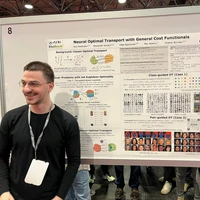
Neural Optimal Transport with General Cost Functionals
We introduce a novel neural network-based algorithm to compute optimal transport (OT) plans for general cost functionals. In contrast to common Euclidean costs, i.e., ell^1 or ell^2, such functionals provide more flexibility and allow using auxiliary information, such as class labels, to construct the required transport map. Existing methods for general costs are discrete and have limitations in practice, i.e. they do not provide an out-of-sample estimation. We address the challenge of designing a continuous OT approach for general costs that generalizes to new data points in high-dimensional spaces, such as images. Additionally, we provide the theoretical error analysis for our recovered transport plans. As an application, we construct a cost functional to map data distributions while preserving the class-wise structure.
Displacement-Sparse Neural Optimal Transport
Optimal transport (OT) aims to find a map T that transports mass from one probability measure to another while minimizing a cost function. Recently, neural OT solvers have gained popularity in high dimensional biological applications such as drug perturbation, due to their superior computational and memory efficiency compared to traditional exact Sinkhorn solvers. However, the overly complex high dimensional maps learned by neural OT solvers often suffer from poor interpretability. Prior work addressed this issue in the context of exact OT solvers by introducing displacement-sparse maps via designed elastic cost, but such method failed to be applied to neural OT settings. In this work, we propose an intuitive and theoretically grounded approach to learning displacement-sparse maps within neural OT solvers. Building on our new formulation, we introduce a novel smoothed ell_0 regularizer that outperforms the ell_1 based alternative from prior work. Leveraging Input Convex Neural Network's flexibility, we further develop a heuristic framework for adaptively controlling sparsity intensity, an approach uniquely enabled by the neural OT paradigm. We demonstrate the necessity of this adaptive framework in large-scale, high-dimensional training, showing not only improved accuracy but also practical ease of use for downstream applications.

Optimal Sets and Solution Paths of ReLU Networks
We develop an analytical framework to characterize the set of optimal ReLU neural networks by reformulating the non-convex training problem as a convex program. We show that the global optima of the convex parameterization are given by a polyhedral set and then extend this characterization to the optimal set of the non-convex training objective. Since all stationary points of the ReLU training problem can be represented as optima of sub-sampled convex programs, our work provides a general expression for all critical points of the non-convex objective. We then leverage our results to provide an optimal pruning algorithm for computing minimal networks, establish conditions for the regularization path of ReLU networks to be continuous, and develop sensitivity results for minimal ReLU networks.

Auto-GNN: Neural Architecture Search of Graph Neural Networks
Graph neural networks (GNN) has been successfully applied to operate on the graph-structured data. Given a specific scenario, rich human expertise and tremendous laborious trials are usually required to identify a suitable GNN architecture. It is because the performance of a GNN architecture is significantly affected by the choice of graph convolution components, such as aggregate function and hidden dimension. Neural architecture search (NAS) has shown its potential in discovering effective deep architectures for learning tasks in image and language modeling. However, existing NAS algorithms cannot be directly applied to the GNN search problem. First, the search space of GNN is different from the ones in existing NAS work. Second, the representation learning capacity of GNN architecture changes obviously with slight architecture modifications. It affects the search efficiency of traditional search methods. Third, widely used techniques in NAS such as parameter sharing might become unstable in GNN. To bridge the gap, we propose the automated graph neural networks (AGNN) framework, which aims to find an optimal GNN architecture within a predefined search space. A reinforcement learning based controller is designed to greedily validate architectures via small steps. AGNN has a novel parameter sharing strategy that enables homogeneous architectures to share parameters, based on a carefully-designed homogeneity definition. Experiments on real-world benchmark datasets demonstrate that the GNN architecture identified by AGNN achieves the best performance, comparing with existing handcrafted models and tradistional search methods.
GraphNAS: Graph Neural Architecture Search with Reinforcement Learning
Graph Neural Networks (GNNs) have been popularly used for analyzing non-Euclidean data such as social network data and biological data. Despite their success, the design of graph neural networks requires a lot of manual work and domain knowledge. In this paper, we propose a Graph Neural Architecture Search method (GraphNAS for short) that enables automatic search of the best graph neural architecture based on reinforcement learning. Specifically, GraphNAS first uses a recurrent network to generate variable-length strings that describe the architectures of graph neural networks, and then trains the recurrent network with reinforcement learning to maximize the expected accuracy of the generated architectures on a validation data set. Extensive experimental results on node classification tasks in both transductive and inductive learning settings demonstrate that GraphNAS can achieve consistently better performance on the Cora, Citeseer, Pubmed citation network, and protein-protein interaction network. On node classification tasks, GraphNAS can design a novel network architecture that rivals the best human-invented architecture in terms of test set accuracy.
Accelerating Neural Architecture Exploration Across Modalities Using Genetic Algorithms
Neural architecture search (NAS), the study of automating the discovery of optimal deep neural network architectures for tasks in domains such as computer vision and natural language processing, has seen rapid growth in the machine learning research community. While there have been many recent advancements in NAS, there is still a significant focus on reducing the computational cost incurred when validating discovered architectures by making search more efficient. Evolutionary algorithms, specifically genetic algorithms, have a history of usage in NAS and continue to gain popularity versus other optimization approaches as a highly efficient way to explore the architecture objective space. Most NAS research efforts have centered around computer vision tasks and only recently have other modalities, such as the rapidly growing field of natural language processing, been investigated in depth. In this work, we show how genetic algorithms can be paired with lightly trained objective predictors in an iterative cycle to accelerate multi-objective architectural exploration in a way that works in the modalities of both machine translation and image classification.



OL-Transformer: A Fast and Universal Surrogate Simulator for Optical Multilayer Thin Film Structures
Deep learning-based methods have recently been established as fast and accurate surrogate simulators for optical multilayer thin film structures. However, existing methods only work for limited types of structures with different material arrangements, preventing their applications towards diverse and universal structures. Here, we propose the Opto-Layer (OL) Transformer to act as a universal surrogate simulator for enormous types of structures. Combined with the technique of structure serialization, our model can predict accurate reflection and transmission spectra for up to 10^{25} different multilayer structures, while still achieving a six-fold degradation in simulation time compared to physical solvers. Further investigation reveals that the general learning ability comes from the fact that our model first learns the physical embeddings and then uses the self-attention mechanism to capture the hidden relationship of light-matter interaction between each layer.
AnalogVNN: A fully modular framework for modeling and optimizing photonic neural networks
AnalogVNN, a simulation framework built on PyTorch which can simulate the effects of optoelectronic noise, limited precision, and signal normalization present in photonic neural network accelerators. We use this framework to train and optimize linear and convolutional neural networks with up to 9 layers and ~1.7 million parameters, while gaining insights into how normalization, activation function, reduced precision, and noise influence accuracy in analog photonic neural networks. By following the same layer structure design present in PyTorch, the AnalogVNN framework allows users to convert most digital neural network models to their analog counterparts with just a few lines of code, taking full advantage of the open-source optimization, deep learning, and GPU acceleration libraries available through PyTorch. Code is available at https://analogvnn.github.io

Graph Neural Networks with Learnable and Optimal Polynomial Bases
Polynomial filters, a kind of Graph Neural Networks, typically use a predetermined polynomial basis and learn the coefficients from the training data. It has been observed that the effectiveness of the model is highly dependent on the property of the polynomial basis. Consequently, two natural and fundamental questions arise: Can we learn a suitable polynomial basis from the training data? Can we determine the optimal polynomial basis for a given graph and node features? In this paper, we propose two spectral GNN models that provide positive answers to the questions posed above. First, inspired by Favard's Theorem, we propose the FavardGNN model, which learns a polynomial basis from the space of all possible orthonormal bases. Second, we examine the supposedly unsolvable definition of optimal polynomial basis from Wang & Zhang (2022) and propose a simple model, OptBasisGNN, which computes the optimal basis for a given graph structure and graph signal. Extensive experiments are conducted to demonstrate the effectiveness of our proposed models.
Finding the Task-Optimal Low-Bit Sub-Distribution in Deep Neural Networks
Quantized neural networks typically require smaller memory footprints and lower computation complexity, which is crucial for efficient deployment. However, quantization inevitably leads to a distribution divergence from the original network, which generally degrades the performance. To tackle this issue, massive efforts have been made, but most existing approaches lack statistical considerations and depend on several manual configurations. In this paper, we present an adaptive-mapping quantization method to learn an optimal latent sub-distribution that is inherent within models and smoothly approximated with a concrete Gaussian Mixture (GM). In particular, the network weights are projected in compliance with the GM-approximated sub-distribution. This sub-distribution evolves along with the weight update in a co-tuning schema guided by the direct task-objective optimization. Sufficient experiments on image classification and object detection over various modern architectures demonstrate the effectiveness, generalization property, and transferability of the proposed method. Besides, an efficient deployment flow for the mobile CPU is developed, achieving up to 7.46times inference acceleration on an octa-core ARM CPU. Our codes have been publicly released at https://github.com/RunpeiDong/DGMS.


Compressing Neural Networks: Towards Determining the Optimal Layer-wise Decomposition
We present a novel global compression framework for deep neural networks that automatically analyzes each layer to identify the optimal per-layer compression ratio, while simultaneously achieving the desired overall compression. Our algorithm hinges on the idea of compressing each convolutional (or fully-connected) layer by slicing its channels into multiple groups and decomposing each group via low-rank decomposition. At the core of our algorithm is the derivation of layer-wise error bounds from the Eckart Young Mirsky theorem. We then leverage these bounds to frame the compression problem as an optimization problem where we wish to minimize the maximum compression error across layers and propose an efficient algorithm towards a solution. Our experiments indicate that our method outperforms existing low-rank compression approaches across a wide range of networks and data sets. We believe that our results open up new avenues for future research into the global performance-size trade-offs of modern neural networks. Our code is available at https://github.com/lucaslie/torchprune.

On the Optimal Memorization Power of ReLU Neural Networks
We study the memorization power of feedforward ReLU neural networks. We show that such networks can memorize any N points that satisfy a mild separability assumption using Oleft(Nright) parameters. Known VC-dimension upper bounds imply that memorizing N samples requires Omega(N) parameters, and hence our construction is optimal up to logarithmic factors. We also give a generalized construction for networks with depth bounded by 1 leq L leq N, for memorizing N samples using O(N/L) parameters. This bound is also optimal up to logarithmic factors. Our construction uses weights with large bit complexity. We prove that having such a large bit complexity is both necessary and sufficient for memorization with a sub-linear number of parameters.
Optimal Input Gain: All You Need to Supercharge a Feed-Forward Neural Network
Linear transformation of the inputs alters the training performance of feed-forward networks that are otherwise equivalent. However, most linear transforms are viewed as a pre-processing operation separate from the actual training. Starting from equivalent networks, it is shown that pre-processing inputs using linear transformation are equivalent to multiplying the negative gradient matrix with an autocorrelation matrix per training iteration. Second order method is proposed to find the autocorrelation matrix that maximizes learning in a given iteration. When the autocorrelation matrix is diagonal, the method optimizes input gains. This optimal input gain (OIG) approach is used to improve two first-order two-stage training algorithms, namely back-propagation (BP) and hidden weight optimization (HWO), which alternately update the input weights and solve linear equations for output weights. Results show that the proposed OIG approach greatly enhances the performance of the first-order algorithms, often allowing them to rival the popular Levenberg-Marquardt approach with far less computation. It is shown that HWO is equivalent to BP with Whitening transformation applied to the inputs. HWO effectively combines Whitening transformation with learning. Thus, OIG improved HWO could be a significant building block to more complex deep learning architectures.

SGD Finds then Tunes Features in Two-Layer Neural Networks with near-Optimal Sample Complexity: A Case Study in the XOR problem
In this work, we consider the optimization process of minibatch stochastic gradient descent (SGD) on a 2-layer neural network with data separated by a quadratic ground truth function. We prove that with data drawn from the d-dimensional Boolean hypercube labeled by the quadratic ``XOR'' function y = -x_ix_j, it is possible to train to a population error o(1) with d :polylog(d) samples. Our result considers simultaneously training both layers of the two-layer-neural network with ReLU activations via standard minibatch SGD on the logistic loss. To our knowledge, this work is the first to give a sample complexity of O(d) for efficiently learning the XOR function on isotropic data on a standard neural network with standard training. Our main technique is showing that the network evolves in two phases: a signal-finding phase where the network is small and many of the neurons evolve independently to find features, and a signal-heavy phase, where SGD maintains and balances the features. We leverage the simultaneous training of the layers to show that it is sufficient for only a small fraction of the neurons to learn features, since those neurons will be amplified by the simultaneous growth of their second layer weights.
Graph Neural Networks for Learning Real-Time Prices in Electricity Market
Solving the optimal power flow (OPF) problem in real-time electricity market improves the efficiency and reliability in the integration of low-carbon energy resources into the power grids. To address the scalability and adaptivity issues of existing end-to-end OPF learning solutions, we propose a new graph neural network (GNN) framework for predicting the electricity market prices from solving OPFs. The proposed GNN-for-OPF framework innovatively exploits the locality property of prices and introduces physics-aware regularization, while attaining reduced model complexity and fast adaptivity to varying grid topology. Numerical tests have validated the learning efficiency and adaptivity improvements of our proposed method over existing approaches.
Spiking Neural Network as Adaptive Event Stream Slicer
Event-based cameras are attracting significant interest as they provide rich edge information, high dynamic range, and high temporal resolution. Many state-of-the-art event-based algorithms rely on splitting the events into fixed groups, resulting in the omission of crucial temporal information, particularly when dealing with diverse motion scenarios (\eg, high/low speed).In this work, we propose SpikeSlicer, a novel-designed plug-and-play event processing method capable of splitting events stream adaptively.SpikeSlicer utilizes a low-energy spiking neural network (SNN) to trigger event slicing. To guide the SNN to fire spikes at optimal time steps, we propose the Spiking Position-aware Loss (SPA-Loss) to modulate the neuron's state. Additionally, we develop a Feedback-Update training strategy that refines the slicing decisions using feedback from the downstream artificial neural network (ANN). Extensive experiments demonstrate that our method yields significant performance improvements in event-based object tracking and recognition. Notably, SpikeSlicer provides a brand-new SNN-ANN cooperation paradigm, where the SNN acts as an efficient, low-energy data processor to assist the ANN in improving downstream performance, injecting new perspectives and potential avenues of exploration.


Optimizing Neural Network Hyperparameters with Gaussian Processes for Dialog Act Classification
Systems based on artificial neural networks (ANNs) have achieved state-of-the-art results in many natural language processing tasks. Although ANNs do not require manually engineered features, ANNs have many hyperparameters to be optimized. The choice of hyperparameters significantly impacts models' performances. However, the ANN hyperparameters are typically chosen by manual, grid, or random search, which either requires expert experiences or is computationally expensive. Recent approaches based on Bayesian optimization using Gaussian processes (GPs) is a more systematic way to automatically pinpoint optimal or near-optimal machine learning hyperparameters. Using a previously published ANN model yielding state-of-the-art results for dialog act classification, we demonstrate that optimizing hyperparameters using GP further improves the results, and reduces the computational time by a factor of 4 compared to a random search. Therefore it is a useful technique for tuning ANN models to yield the best performances for natural language processing tasks.

Scalable Neural Network Kernels
We introduce the concept of scalable neural network kernels (SNNKs), the replacements of regular feedforward layers (FFLs), capable of approximating the latter, but with favorable computational properties. SNNKs effectively disentangle the inputs from the parameters of the neural network in the FFL, only to connect them in the final computation via the dot-product kernel. They are also strictly more expressive, as allowing to model complicated relationships beyond the functions of the dot-products of parameter-input vectors. We also introduce the neural network bundling process that applies SNNKs to compactify deep neural network architectures, resulting in additional compression gains. In its extreme version, it leads to the fully bundled network whose optimal parameters can be expressed via explicit formulae for several loss functions (e.g. mean squared error), opening a possibility to bypass backpropagation. As a by-product of our analysis, we introduce the mechanism of the universal random features (or URFs), applied to instantiate several SNNK variants, and interesting on its own in the context of scalable kernel methods. We provide rigorous theoretical analysis of all these concepts as well as an extensive empirical evaluation, ranging from point-wise kernel estimation to Transformers' fine-tuning with novel adapter layers inspired by SNNKs. Our mechanism provides up to 5x reduction in the number of trainable parameters, while maintaining competitive accuracy.
Optimising Event-Driven Spiking Neural Network with Regularisation and Cutoff
Spiking neural networks (SNNs), a variant of artificial neural networks (ANNs) with the benefit of energy efficiency, have achieved the accuracy close to its ANN counterparts, on benchmark datasets such as CIFAR10/100 and ImageNet. However, comparing with frame-based input (e.g., images), event-based inputs from e.g., Dynamic Vision Sensor (DVS) can make a better use of SNNs thanks to the SNNs' asynchronous working mechanism. In this paper, we strengthen the marriage between SNNs and event-based inputs with a proposal to consider anytime optimal inference SNNs, or AOI-SNNs, which can terminate anytime during the inference to achieve optimal inference result. Two novel optimisation techniques are presented to achieve AOI-SNNs: a regularisation and a cutoff. The regularisation enables the training and construction of SNNs with optimised performance, and the cutoff technique optimises the inference of SNNs on event-driven inputs. We conduct an extensive set of experiments on multiple benchmark event-based datasets, including CIFAR10-DVS, N-Caltech101 and DVS128 Gesture. The experimental results demonstrate that our techniques are superior to the state-of-the-art with respect to the accuracy and latency.
Learned Low Precision Graph Neural Networks
Deep Graph Neural Networks (GNNs) show promising performance on a range of graph tasks, yet at present are costly to run and lack many of the optimisations applied to DNNs. We show, for the first time, how to systematically quantise GNNs with minimal or no loss in performance using Network Architecture Search (NAS). We define the possible quantisation search space of GNNs. The proposed novel NAS mechanism, named Low Precision Graph NAS (LPGNAS), constrains both architecture and quantisation choices to be differentiable. LPGNAS learns the optimal architecture coupled with the best quantisation strategy for different components in the GNN automatically using back-propagation in a single search round. On eight different datasets, solving the task of classifying unseen nodes in a graph, LPGNAS generates quantised models with significant reductions in both model and buffer sizes but with similar accuracy to manually designed networks and other NAS results. In particular, on the Pubmed dataset, LPGNAS shows a better size-accuracy Pareto frontier compared to seven other manual and searched baselines, offering a 2.3 times reduction in model size but a 0.4% increase in accuracy when compared to the best NAS competitor. Finally, from our collected quantisation statistics on a wide range of datasets, we suggest a W4A8 (4-bit weights, 8-bit activations) quantisation strategy might be the bottleneck for naive GNN quantisations.
Deep Neural Networks Tend To Extrapolate Predictably
Conventional wisdom suggests that neural network predictions tend to be unpredictable and overconfident when faced with out-of-distribution (OOD) inputs. Our work reassesses this assumption for neural networks with high-dimensional inputs. Rather than extrapolating in arbitrary ways, we observe that neural network predictions often tend towards a constant value as input data becomes increasingly OOD. Moreover, we find that this value often closely approximates the optimal constant solution (OCS), i.e., the prediction that minimizes the average loss over the training data without observing the input. We present results showing this phenomenon across 8 datasets with different distributional shifts (including CIFAR10-C and ImageNet-R, S), different loss functions (cross entropy, MSE, and Gaussian NLL), and different architectures (CNNs and transformers). Furthermore, we present an explanation for this behavior, which we first validate empirically and then study theoretically in a simplified setting involving deep homogeneous networks with ReLU activations. Finally, we show how one can leverage our insights in practice to enable risk-sensitive decision-making in the presence of OOD inputs.
Masked Bayesian Neural Networks : Theoretical Guarantee and its Posterior Inference
Bayesian approaches for learning deep neural networks (BNN) have been received much attention and successfully applied to various applications. Particularly, BNNs have the merit of having better generalization ability as well as better uncertainty quantification. For the success of BNN, search an appropriate architecture of the neural networks is an important task, and various algorithms to find good sparse neural networks have been proposed. In this paper, we propose a new node-sparse BNN model which has good theoretical properties and is computationally feasible. We prove that the posterior concentration rate to the true model is near minimax optimal and adaptive to the smoothness of the true model. In particular the adaptiveness is the first of its kind for node-sparse BNNs. In addition, we develop a novel MCMC algorithm which makes the Bayesian inference of the node-sparse BNN model feasible in practice.
Accelerator-aware Neural Network Design using AutoML
While neural network hardware accelerators provide a substantial amount of raw compute throughput, the models deployed on them must be co-designed for the underlying hardware architecture to obtain the optimal system performance. We present a class of computer vision models designed using hardware-aware neural architecture search and customized to run on the Edge TPU, Google's neural network hardware accelerator for low-power, edge devices. For the Edge TPU in Coral devices, these models enable real-time image classification performance while achieving accuracy typically seen only with larger, compute-heavy models running in data centers. On Pixel 4's Edge TPU, these models improve the accuracy-latency tradeoff over existing SoTA mobile models.
SuperGlue: Learning Feature Matching with Graph Neural Networks
This paper introduces SuperGlue, a neural network that matches two sets of local features by jointly finding correspondences and rejecting non-matchable points. Assignments are estimated by solving a differentiable optimal transport problem, whose costs are predicted by a graph neural network. We introduce a flexible context aggregation mechanism based on attention, enabling SuperGlue to reason about the underlying 3D scene and feature assignments jointly. Compared to traditional, hand-designed heuristics, our technique learns priors over geometric transformations and regularities of the 3D world through end-to-end training from image pairs. SuperGlue outperforms other learned approaches and achieves state-of-the-art results on the task of pose estimation in challenging real-world indoor and outdoor environments. The proposed method performs matching in real-time on a modern GPU and can be readily integrated into modern SfM or SLAM systems. The code and trained weights are publicly available at https://github.com/magicleap/SuperGluePretrainedNetwork.
Convolutional Neural Networks and Volcano Plots: Screening and Prediction of Two-Dimensional Single-Atom Catalysts
Single-atom catalysts (SACs) have emerged as frontiers for catalyzing chemical reactions, yet the diverse combinations of active elements and support materials, the nature of coordination environments, elude traditional methodologies in searching optimal SAC systems with superior catalytic performance. Herein, by integrating multi-branch Convolutional Neural Network (CNN) analysis models to hybrid descriptor based activity volcano plot, 2D SAC system composed of diverse metallic single atoms anchored on six type of 2D supports, including graphitic carbon nitride, nitrogen-doped graphene, graphene with dual-vacancy, black phosphorous, boron nitride, and C2N, are screened for efficient CO2RR. Starting from establishing a correlation map between the adsorption energies of intermediates and diverse electronic and elementary descriptors, sole singular descriptor lost magic to predict catalytic activity. Deep learning method utilizing multi-branch CNN model therefore was employed, using 2D electronic density of states as input to predict adsorption energies. Hybrid-descriptor enveloping both C- and O-types of CO2RR intermediates was introduced to construct volcano plots and limiting potential periodic table, aiming for intuitive screening of catalyst candidates for efficient CO2 reduction to CH4. The eDOS occlusion experiments were performed to unravel individual orbital contribution to adsorption energy. To explore the electronic scale principle governing practical engineering catalytic CO2RR activity, orbitalwise eDOS shifting experiments based on CNN model were employed. The study involves examining the adsorption energy and, consequently, catalytic activities while varying supported single atoms. This work offers a tangible framework to inform both theoretical screening and experimental synthesis, thereby paving the way for systematically designing efficient SACs.
Wide and Deep Neural Networks Achieve Optimality for Classification
While neural networks are used for classification tasks across domains, a long-standing open problem in machine learning is determining whether neural networks trained using standard procedures are optimal for classification, i.e., whether such models minimize the probability of misclassification for arbitrary data distributions. In this work, we identify and construct an explicit set of neural network classifiers that achieve optimality. Since effective neural networks in practice are typically both wide and deep, we analyze infinitely wide networks that are also infinitely deep. In particular, using the recent connection between infinitely wide neural networks and Neural Tangent Kernels, we provide explicit activation functions that can be used to construct networks that achieve optimality. Interestingly, these activation functions are simple and easy to implement, yet differ from commonly used activations such as ReLU or sigmoid. More generally, we create a taxonomy of infinitely wide and deep networks and show that these models implement one of three well-known classifiers depending on the activation function used: (1) 1-nearest neighbor (model predictions are given by the label of the nearest training example); (2) majority vote (model predictions are given by the label of the class with greatest representation in the training set); or (3) singular kernel classifiers (a set of classifiers containing those that achieve optimality). Our results highlight the benefit of using deep networks for classification tasks, in contrast to regression tasks, where excessive depth is harmful.
Net-Zero: A Comparative Study on Neural Network Design for Climate-Economic PDEs Under Uncertainty
Climate-economic modeling under uncertainty presents significant computational challenges that may limit policymakers' ability to address climate change effectively. This paper explores neural network-based approaches for solving high-dimensional optimal control problems arising from models that incorporate ambiguity aversion in climate mitigation decisions. We develop a continuous-time endogenous-growth economic model that accounts for multiple mitigation pathways, including emission-free capital and carbon intensity reductions. Given the inherent complexity and high dimensionality of these models, traditional numerical methods become computationally intractable. We benchmark several neural network architectures against finite-difference generated solutions, evaluating their ability to capture the dynamic interactions between uncertainty, technology transitions, and optimal climate policy. Our findings demonstrate that appropriate neural architecture selection significantly impacts both solution accuracy and computational efficiency when modeling climate-economic systems under uncertainty. These methodological advances enable more sophisticated modeling of climate policy decisions, allowing for better representation of technology transitions and uncertainty-critical elements for developing effective mitigation strategies in the face of climate change.

A Low-complexity Structured Neural Network to Realize States of Dynamical Systems
Data-driven learning is rapidly evolving and places a new perspective on realizing state-space dynamical systems. However, dynamical systems derived from nonlinear ordinary differential equations (ODEs) suffer from limitations in computational efficiency. Thus, this paper stems from data-driven learning to advance states of dynamical systems utilizing a structured neural network (StNN). The proposed learning technique also seeks to identify an optimal, low-complexity operator to solve dynamical systems, the so-called Hankel operator, derived from time-delay measurements. Thus, we utilize the StNN based on the Hankel operator to solve dynamical systems as an alternative to existing data-driven techniques. We show that the proposed StNN reduces the number of parameters and computational complexity compared with the conventional neural networks and also with the classical data-driven techniques, such as Sparse Identification of Nonlinear Dynamics (SINDy) and Hankel Alternative view of Koopman (HAVOK), which is commonly known as delay-Dynamic Mode Decomposition(DMD) or Hankel-DMD. More specifically, we present numerical simulations to solve dynamical systems utilizing the StNN based on the Hankel operator beginning from the fundamental Lotka-Volterra model, where we compare the StNN with the LEarning Across Dynamical Systems (LEADS), and extend our analysis to highly nonlinear and chaotic Lorenz systems, comparing the StNN with conventional neural networks, SINDy, and HAVOK. Hence, we show that the proposed StNN paves the way for realizing state-space dynamical systems with a low-complexity learning algorithm, enabling prediction and understanding of future states.
Revisiting Weighted Aggregation in Federated Learning with Neural Networks
In federated learning (FL), weighted aggregation of local models is conducted to generate a global model, and the aggregation weights are normalized (the sum of weights is 1) and proportional to the local data sizes. In this paper, we revisit the weighted aggregation process and gain new insights into the training dynamics of FL. First, we find that the sum of weights can be smaller than 1, causing global weight shrinking effect (analogous to weight decay) and improving generalization. We explore how the optimal shrinking factor is affected by clients' data heterogeneity and local epochs. Second, we dive into the relative aggregation weights among clients to depict the clients' importance. We develop client coherence to study the learning dynamics and find a critical point that exists. Before entering the critical point, more coherent clients play more essential roles in generalization. Based on the above insights, we propose an effective method for Federated Learning with Learnable Aggregation Weights, named as FedLAW. Extensive experiments verify that our method can improve the generalization of the global model by a large margin on different datasets and models.


Training Bayesian Neural Networks with Sparse Subspace Variational Inference
Bayesian neural networks (BNNs) offer uncertainty quantification but come with the downside of substantially increased training and inference costs. Sparse BNNs have been investigated for efficient inference, typically by either slowly introducing sparsity throughout the training or by post-training compression of dense BNNs. The dilemma of how to cut down massive training costs remains, particularly given the requirement to learn about the uncertainty. To solve this challenge, we introduce Sparse Subspace Variational Inference (SSVI), the first fully sparse BNN framework that maintains a consistently highly sparse Bayesian model throughout the training and inference phases. Starting from a randomly initialized low-dimensional sparse subspace, our approach alternately optimizes the sparse subspace basis selection and its associated parameters. While basis selection is characterized as a non-differentiable problem, we approximate the optimal solution with a removal-and-addition strategy, guided by novel criteria based on weight distribution statistics. Our extensive experiments show that SSVI sets new benchmarks in crafting sparse BNNs, achieving, for instance, a 10-20x compression in model size with under 3\% performance drop, and up to 20x FLOPs reduction during training compared with dense VI training. Remarkably, SSVI also demonstrates enhanced robustness to hyperparameters, reducing the need for intricate tuning in VI and occasionally even surpassing VI-trained dense BNNs on both accuracy and uncertainty metrics.
Exact Combinatorial Optimization with Temporo-Attentional Graph Neural Networks
Combinatorial optimization finds an optimal solution within a discrete set of variables and constraints. The field has seen tremendous progress both in research and industry. With the success of deep learning in the past decade, a recent trend in combinatorial optimization has been to improve state-of-the-art combinatorial optimization solvers by replacing key heuristic components with machine learning (ML) models. In this paper, we investigate two essential aspects of machine learning algorithms for combinatorial optimization: temporal characteristics and attention. We argue that for the task of variable selection in the branch-and-bound (B&B) algorithm, incorporating the temporal information as well as the bipartite graph attention improves the solver's performance. We support our claims with intuitions and numerical results over several standard datasets used in the literature and competitions. Code is available at: https://developer.huaweicloud.com/develop/aigallery/notebook/detail?id=047c6cf2-8463-40d7-b92f-7b2ca998e935
Tensor Programs VI: Feature Learning in Infinite-Depth Neural Networks
By classifying infinite-width neural networks and identifying the *optimal* limit, Tensor Programs IV and V demonstrated a universal way, called muP, for *widthwise hyperparameter transfer*, i.e., predicting optimal hyperparameters of wide neural networks from narrow ones. Here we investigate the analogous classification for *depthwise parametrizations* of deep residual networks (resnets). We classify depthwise parametrizations of block multiplier and learning rate by their infinite-width-then-depth limits. In resnets where each block has only one layer, we identify a unique optimal parametrization, called Depth-muP that extends muP and show empirically it admits depthwise hyperparameter transfer. We identify *feature diversity* as a crucial factor in deep networks, and Depth-muP can be characterized as maximizing both feature learning and feature diversity. Exploiting this, we find that absolute value, among all homogeneous nonlinearities, maximizes feature diversity and indeed empirically leads to significantly better performance. However, if each block is deeper (such as modern transformers), then we find fundamental limitations in all possible infinite-depth limits of such parametrizations, which we illustrate both theoretically and empirically on simple networks as well as Megatron transformer trained on Common Crawl.

Benign Overfitting in Deep Neural Networks under Lazy Training
This paper focuses on over-parameterized deep neural networks (DNNs) with ReLU activation functions and proves that when the data distribution is well-separated, DNNs can achieve Bayes-optimal test error for classification while obtaining (nearly) zero-training error under the lazy training regime. For this purpose, we unify three interrelated concepts of overparameterization, benign overfitting, and the Lipschitz constant of DNNs. Our results indicate that interpolating with smoother functions leads to better generalization. Furthermore, we investigate the special case where interpolating smooth ground-truth functions is performed by DNNs under the Neural Tangent Kernel (NTK) regime for generalization. Our result demonstrates that the generalization error converges to a constant order that only depends on label noise and initialization noise, which theoretically verifies benign overfitting. Our analysis provides a tight lower bound on the normalized margin under non-smooth activation functions, as well as the minimum eigenvalue of NTK under high-dimensional settings, which has its own interest in learning theory.


Random Feature Amplification: Feature Learning and Generalization in Neural Networks
In this work, we provide a characterization of the feature-learning process in two-layer ReLU networks trained by gradient descent on the logistic loss following random initialization. We consider data with binary labels that are generated by an XOR-like function of the input features. We permit a constant fraction of the training labels to be corrupted by an adversary. We show that, although linear classifiers are no better than random guessing for the distribution we consider, two-layer ReLU networks trained by gradient descent achieve generalization error close to the label noise rate. We develop a novel proof technique that shows that at initialization, the vast majority of neurons function as random features that are only weakly correlated with useful features, and the gradient descent dynamics 'amplify' these weak, random features to strong, useful features.

Parallel Deep Neural Networks Have Zero Duality Gap
Training deep neural networks is a challenging non-convex optimization problem. Recent work has proven that the strong duality holds (which means zero duality gap) for regularized finite-width two-layer ReLU networks and consequently provided an equivalent convex training problem. However, extending this result to deeper networks remains to be an open problem. In this paper, we prove that the duality gap for deeper linear networks with vector outputs is non-zero. In contrast, we show that the zero duality gap can be obtained by stacking standard deep networks in parallel, which we call a parallel architecture, and modifying the regularization. Therefore, we prove the strong duality and existence of equivalent convex problems that enable globally optimal training of deep networks. As a by-product of our analysis, we demonstrate that the weight decay regularization on the network parameters explicitly encourages low-rank solutions via closed-form expressions. In addition, we show that strong duality holds for three-layer standard ReLU networks given rank-1 data matrices.
A disciplined approach to neural network hyper-parameters: Part 1 -- learning rate, batch size, momentum, and weight decay
Although deep learning has produced dazzling successes for applications of image, speech, and video processing in the past few years, most trainings are with suboptimal hyper-parameters, requiring unnecessarily long training times. Setting the hyper-parameters remains a black art that requires years of experience to acquire. This report proposes several efficient ways to set the hyper-parameters that significantly reduce training time and improves performance. Specifically, this report shows how to examine the training validation/test loss function for subtle clues of underfitting and overfitting and suggests guidelines for moving toward the optimal balance point. Then it discusses how to increase/decrease the learning rate/momentum to speed up training. Our experiments show that it is crucial to balance every manner of regularization for each dataset and architecture. Weight decay is used as a sample regularizer to show how its optimal value is tightly coupled with the learning rates and momentums. Files to help replicate the results reported here are available.
Neural Network Verification with Branch-and-Bound for General Nonlinearities
Branch-and-bound (BaB) is among the most effective techniques for neural network (NN) verification. However, existing works on BaB for NN verification have mostly focused on NNs with piecewise linear activations, especially ReLU networks. In this paper, we develop a general framework, named GenBaB, to conduct BaB on general nonlinearities to verify NNs with general architectures, based on linear bound propagation for NN verification. To decide which neuron to branch, we design a new branching heuristic which leverages linear bounds as shortcuts to efficiently estimate the potential improvement after branching. To decide nontrivial branching points for general nonlinear functions, we propose to pre-optimize branching points, which can be efficiently leveraged during verification with a lookup table. We demonstrate the effectiveness of our GenBaB on verifying a wide range of NNs, including NNs with activation functions such as Sigmoid, Tanh, Sine and GeLU, as well as NNs involving multi-dimensional nonlinear operations such as multiplications in LSTMs and Vision Transformers. Our framework also allows the verification of general nonlinear computation graphs and enables verification applications beyond simple NNs, particularly for AC Optimal Power Flow (ACOPF). GenBaB is part of the latest alpha,!beta-CROWN, the winner of the 4th and the 5th International Verification of Neural Networks Competition (VNN-COMP 2023 and 2024).

Vanishing Variance Problem in Fully Decentralized Neural-Network Systems
Federated learning and gossip learning are emerging methodologies designed to mitigate data privacy concerns by retaining training data on client devices and exclusively sharing locally-trained machine learning (ML) models with others. The primary distinction between the two lies in their approach to model aggregation: federated learning employs a centralized parameter server, whereas gossip learning adopts a fully decentralized mechanism, enabling direct model exchanges among nodes. This decentralized nature often positions gossip learning as less efficient compared to federated learning. Both methodologies involve a critical step: computing a representation of received ML models and integrating this representation into the existing model. Conventionally, this representation is derived by averaging the received models, exemplified by the FedAVG algorithm. Our findings suggest that this averaging approach inherently introduces a potential delay in model convergence. We identify the underlying cause and refer to it as the "vanishing variance" problem, where averaging across uncorrelated ML models undermines the optimal variance established by the Xavier weight initialization. Unlike federated learning where the central server ensures model correlation, and unlike traditional gossip learning which circumvents this problem through model partitioning and sampling, our research introduces a variance-corrected model averaging algorithm. This novel algorithm preserves the optimal variance needed during model averaging, irrespective of network topology or non-IID data distributions. Our extensive simulation results demonstrate that our approach enables gossip learning to achieve convergence efficiency comparable to that of federated learning.
A Large-Scale Study of Probabilistic Calibration in Neural Network Regression
Accurate probabilistic predictions are essential for optimal decision making. While neural network miscalibration has been studied primarily in classification, we investigate this in the less-explored domain of regression. We conduct the largest empirical study to date to assess the probabilistic calibration of neural networks. We also analyze the performance of recalibration, conformal, and regularization methods to enhance probabilistic calibration. Additionally, we introduce novel differentiable recalibration and regularization methods, uncovering new insights into their effectiveness. Our findings reveal that regularization methods offer a favorable tradeoff between calibration and sharpness. Post-hoc methods exhibit superior probabilistic calibration, which we attribute to the finite-sample coverage guarantee of conformal prediction. Furthermore, we demonstrate that quantile recalibration can be considered as a specific case of conformal prediction. Our study is fully reproducible and implemented in a common code base for fair comparisons.

Wireless-Enabled Asynchronous Federated Fourier Neural Network for Turbulence Prediction in Urban Air Mobility (UAM)
To meet the growing mobility needs in intra-city transportation, the concept of urban air mobility (UAM) has been proposed in which vertical takeoff and landing (VTOL) aircraft are used to provide a ride-hailing service. In UAM, aircraft can operate in designated air spaces known as corridors, that link the aerodromes. A reliable communication network between GBSs and aircraft enables UAM to adequately utilize the airspace and create a fast, efficient, and safe transportation system. In this paper, to characterize the wireless connectivity performance for UAM, a spatial model is proposed. For this setup, the distribution of the distance between an arbitrarily selected GBS and its associated aircraft and the Laplace transform of the interference experienced by the GBS are derived. Using these results, the signal-to-interference ratio (SIR)-based connectivity probability is determined to capture the connectivity performance of the UAM aircraft-to-ground communication network. Then, leveraging these connectivity results, a wireless-enabled asynchronous federated learning (AFL) framework that uses a Fourier neural network is proposed to tackle the challenging problem of turbulence prediction during UAM operations. For this AFL scheme, a staleness-aware global aggregation scheme is introduced to expedite the convergence to the optimal turbulence prediction model used by UAM aircraft. Simulation results validate the theoretical derivations for the UAM wireless connectivity. The results also demonstrate that the proposed AFL framework converges to the optimal turbulence prediction model faster than the synchronous federated learning baselines and a staleness-free AFL approach. Furthermore, the results characterize the performance of wireless connectivity and convergence of the aircraft's turbulence model under different parameter settings, offering useful UAM design guidelines.
Trained Rank Pruning for Efficient Deep Neural Networks
The performance of Deep Neural Networks (DNNs) keeps elevating in recent years with increasing network depth and width. To enable DNNs on edge devices like mobile phones, researchers proposed several network compression methods including pruning, quantization and factorization. Among the factorization-based approaches, low-rank approximation has been widely adopted because of its solid theoretical rationale and efficient implementations. Several previous works attempted to directly approximate a pre-trained model by low-rank decomposition; however, small approximation errors in parameters can ripple a large prediction loss. As a result, performance usually drops significantly and a sophisticated fine-tuning is required to recover accuracy. We argue that it is not optimal to separate low-rank approximation from training. Unlike previous works, this paper integrates low rank approximation and regularization into the training. We propose Trained Rank Pruning (TRP), which iterates low rank approximation and training. TRP maintains the capacity of original network while imposes low-rank constraints during training. A stochastic sub-gradient descent optimized nuclear regularization is utilized to further encourage low rank in TRP. The TRP trained network has low-rank structure in nature, and can be approximated with negligible performance loss, eliminating fine-tuning after low rank approximation. The methods are comprehensively evaluated on CIFAR-10 and ImageNet, outperforming previous compression methods using low rank approximation. Code is available: https://github.com/yuhuixu1993/Trained-Rank-Pruning

PromptFlow: Training Prompts Like Neural Networks
Large Language Models (LLMs) have demonstrated profound impact on Natural Language Processing (NLP) tasks. However, their effective deployment across diverse domains often require domain-specific adaptation strategies, as generic models may underperform when faced with specialized data distributions. Recent advances in prompt engineering (PE) offer a promising alternative to extensive retraining by refining input instructions to align LLM outputs with task objectives. This paradigm has emerged as a rapid and versatile approach for model fine-tuning. Despite its potential, manual prompt design remains labor-intensive and heavily depends on specialized expertise, often requiring iterative human effort to achieve optimal formulations. To address this limitation, automated prompt engineering methodologies have been developed to systematically generate task-specific prompts. However, current implementations predominantly employ static update rules and lack mechanisms for dynamic strategy selection, resulting in suboptimal adaptation to varying NLP task requirements. Furthermore, most methods treat and update the whole prompts at each step, without considering editing prompt sections at a finer granularity. At last, in particular, the problem of how to recycle experience in LLM is still underexplored. To this end, we propose the PromptFlow, a modular training framework inspired by TensorFlow, which integrates meta-prompts, operators, optimization, and evaluator. Our framework can be equipped with the latest optimization methods and autonomously explores optimal prompt refinement trajectories through gradient-based meta-learning, requiring minimal task-specific training data. Specifically, we devise a reinforcement learning method to recycle experience for LLM in the PE process. Finally, we conduct extensive experiments on various datasets, and demonstrate the effectiveness of PromptFlow.
Neural Solvers for Fast and Accurate Numerical Optimal Control
Synthesizing optimal controllers for dynamical systems often involves solving optimization problems with hard real-time constraints. These constraints determine the class of numerical methods that can be applied: computationally expensive but accurate numerical routines are replaced by fast and inaccurate methods, trading inference time for solution accuracy. This paper provides techniques to improve the quality of optimized control policies given a fixed computational budget. We achieve the above via a hypersolvers approach, which hybridizes a differential equation solver and a neural network. The performance is evaluated in direct and receding-horizon optimal control tasks in both low and high dimensions, where the proposed approach shows consistent Pareto improvements in solution accuracy and control performance.


WeightFlow: Learning Stochastic Dynamics via Evolving Weight of Neural Network
Modeling stochastic dynamics from discrete observations is a key interdisciplinary challenge. Existing methods often fail to estimate the continuous evolution of probability densities from trajectories or face the curse of dimensionality. To address these limitations, we presents a novel paradigm: modeling dynamics directly in the weight space of a neural network by projecting the evolving probability distribution. We first theoretically establish the connection between dynamic optimal transport in measure space and an equivalent energy functional in weight space. Subsequently, we design WeightFlow, which constructs the neural network weights into a graph and learns its evolution via a graph controlled differential equation. Experiments on interdisciplinary datasets demonstrate that WeightFlow improves performance by an average of 43.02\% over state-of-the-art methods, providing an effective and scalable solution for modeling high-dimensional stochastic dynamics.
SGUQ: Staged Graph Convolution Neural Network for Alzheimer's Disease Diagnosis using Multi-Omics Data
Alzheimer's disease (AD) is a chronic neurodegenerative disorder and the leading cause of dementia, significantly impacting cost, mortality, and burden worldwide. The advent of high-throughput omics technologies, such as genomics, transcriptomics, proteomics, and epigenomics, has revolutionized the molecular understanding of AD. Conventional AI approaches typically require the completion of all omics data at the outset to achieve optimal AD diagnosis, which are inefficient and may be unnecessary. To reduce the clinical cost and improve the accuracy of AD diagnosis using multi-omics data, we propose a novel staged graph convolutional network with uncertainty quantification (SGUQ). SGUQ begins with mRNA and progressively incorporates DNA methylation and miRNA data only when necessary, reducing overall costs and exposure to harmful tests. Experimental results indicate that 46.23% of the samples can be reliably predicted using only single-modal omics data (mRNA), while an additional 16.04% of the samples can achieve reliable predictions when combining two omics data types (mRNA + DNA methylation). In addition, the proposed staged SGUQ achieved an accuracy of 0.858 on ROSMAP dataset, which outperformed existing methods significantly. The proposed SGUQ can not only be applied to AD diagnosis using multi-omics data but also has the potential for clinical decision-making using multi-viewed data. Our implementation is publicly available at https://github.com/chenzhao2023/multiomicsuncertainty.
A Symmetry-Aware Exploration of Bayesian Neural Network Posteriors
The distribution of the weights of modern deep neural networks (DNNs) - crucial for uncertainty quantification and robustness - is an eminently complex object due to its extremely high dimensionality. This paper proposes one of the first large-scale explorations of the posterior distribution of deep Bayesian Neural Networks (BNNs), expanding its study to real-world vision tasks and architectures. Specifically, we investigate the optimal approach for approximating the posterior, analyze the connection between posterior quality and uncertainty quantification, delve into the impact of modes on the posterior, and explore methods for visualizing the posterior. Moreover, we uncover weight-space symmetries as a critical aspect for understanding the posterior. To this extent, we develop an in-depth assessment of the impact of both permutation and scaling symmetries that tend to obfuscate the Bayesian posterior. While the first type of transformation is known for duplicating modes, we explore the relationship between the latter and L2 regularization, challenging previous misconceptions. Finally, to help the community improve our understanding of the Bayesian posterior, we will shortly release the first large-scale checkpoint dataset, including thousands of real-world models and our codes.

Fast as CHITA: Neural Network Pruning with Combinatorial Optimization
The sheer size of modern neural networks makes model serving a serious computational challenge. A popular class of compression techniques overcomes this challenge by pruning or sparsifying the weights of pretrained networks. While useful, these techniques often face serious tradeoffs between computational requirements and compression quality. In this work, we propose a novel optimization-based pruning framework that considers the combined effect of pruning (and updating) multiple weights subject to a sparsity constraint. Our approach, CHITA, extends the classical Optimal Brain Surgeon framework and results in significant improvements in speed, memory, and performance over existing optimization-based approaches for network pruning. CHITA's main workhorse performs combinatorial optimization updates on a memory-friendly representation of local quadratic approximation(s) of the loss function. On a standard benchmark of pretrained models and datasets, CHITA leads to significantly better sparsity-accuracy tradeoffs than competing methods. For example, for MLPNet with only 2% of the weights retained, our approach improves the accuracy by 63% relative to the state of the art. Furthermore, when used in conjunction with fine-tuning SGD steps, our method achieves significant accuracy gains over the state-of-the-art approaches.

Physics-Informed Deep Neural Network Method for Limited Observability State Estimation
The precise knowledge regarding the state of the power grid is important in order to ensure optimal and reliable grid operation. Specifically, knowing the state of the distribution grid becomes increasingly important as more renewable energy sources are connected directly into the distribution network, increasing the fluctuations of the injected power. In this paper, we consider the case when the distribution grid becomes partially observable, and the state estimation problem is under-determined. We present a new methodology that leverages a deep neural network (DNN) to estimate the grid state. The standard DNN training method is modified to explicitly incorporate the physical information of the grid topology and line/shunt admittance. We show that our method leads to a superior accuracy of the estimation when compared to the case when no physical information is provided. Finally, we compare the performance of our method to the standard state estimation approach, which is based on the weighted least squares with pseudo-measurements, and show that our method performs significantly better with respect to the estimation accuracy.

A Scalable AutoML Approach Based on Graph Neural Networks
AutoML systems build machine learning models automatically by performing a search over valid data transformations and learners, along with hyper-parameter optimization for each learner. Many AutoML systems use meta-learning to guide search for optimal pipelines. In this work, we present a novel meta-learning system called KGpip which, (1) builds a database of datasets and corresponding pipelines by mining thousands of scripts with program analysis, (2) uses dataset embeddings to find similar datasets in the database based on its content instead of metadata-based features, (3) models AutoML pipeline creation as a graph generation problem, to succinctly characterize the diverse pipelines seen for a single dataset. KGpip's meta-learning is a sub-component for AutoML systems. We demonstrate this by integrating KGpip with two AutoML systems. Our comprehensive evaluation using 126 datasets, including those used by the state-of-the-art systems, shows that KGpip significantly outperforms these systems.


TRP: Trained Rank Pruning for Efficient Deep Neural Networks
To enable DNNs on edge devices like mobile phones, low-rank approximation has been widely adopted because of its solid theoretical rationale and efficient implementations. Several previous works attempted to directly approximate a pretrained model by low-rank decomposition; however, small approximation errors in parameters can ripple over a large prediction loss. As a result, performance usually drops significantly and a sophisticated effort on fine-tuning is required to recover accuracy. Apparently, it is not optimal to separate low-rank approximation from training. Unlike previous works, this paper integrates low rank approximation and regularization into the training process. We propose Trained Rank Pruning (TRP), which alternates between low rank approximation and training. TRP maintains the capacity of the original network while imposing low-rank constraints during training. A nuclear regularization optimized by stochastic sub-gradient descent is utilized to further promote low rank in TRP. The TRP trained network inherently has a low-rank structure, and is approximated with negligible performance loss, thus eliminating the fine-tuning process after low rank decomposition. The proposed method is comprehensively evaluated on CIFAR-10 and ImageNet, outperforming previous compression methods using low rank approximation.
Quantization Range Estimation for Convolutional Neural Networks
Post-training quantization for reducing the storage of deep neural network models has been demonstrated to be an effective way in various tasks. However, low-bit quantization while maintaining model accuracy is a challenging problem. In this paper, we present a range estimation method to improve the quantization performance for post-training quantization. We model the range estimation into an optimization problem of minimizing quantization errors by layer-wise local minima. We prove this problem is locally convex and present an efficient search algorithm to find the optimal solution. We propose the application of the above search algorithm to the transformed weights space to do further improvement in practice. Our experiments demonstrate that our method outperforms state-of-the-art performance generally on top-1 accuracy for image classification tasks on the ResNet series models and Inception-v3 model. The experimental results show that the proposed method has almost no loss of top-1 accuracy in 8-bit and 6-bit settings for image classifications, and the accuracy of 4-bit quantization is also significantly improved. The code is available at https://github.com/codeiscommitting/REQuant.
Population Based Training of Neural Networks
Neural networks dominate the modern machine learning landscape, but their training and success still suffer from sensitivity to empirical choices of hyperparameters such as model architecture, loss function, and optimisation algorithm. In this work we present Population Based Training (PBT), a simple asynchronous optimisation algorithm which effectively utilises a fixed computational budget to jointly optimise a population of models and their hyperparameters to maximise performance. Importantly, PBT discovers a schedule of hyperparameter settings rather than following the generally sub-optimal strategy of trying to find a single fixed set to use for the whole course of training. With just a small modification to a typical distributed hyperparameter training framework, our method allows robust and reliable training of models. We demonstrate the effectiveness of PBT on deep reinforcement learning problems, showing faster wall-clock convergence and higher final performance of agents by optimising over a suite of hyperparameters. In addition, we show the same method can be applied to supervised learning for machine translation, where PBT is used to maximise the BLEU score directly, and also to training of Generative Adversarial Networks to maximise the Inception score of generated images. In all cases PBT results in the automatic discovery of hyperparameter schedules and model selection which results in stable training and better final performance.
Differentiable Learning of Generalized Structured Matrices for Efficient Deep Neural Networks
This paper investigates efficient deep neural networks (DNNs) to replace dense unstructured weight matrices with structured ones that possess desired properties. The challenge arises because the optimal weight matrix structure in popular neural network models is obscure in most cases and may vary from layer to layer even in the same network. Prior structured matrices proposed for efficient DNNs were mostly hand-crafted without a generalized framework to systematically learn them. To address this issue, we propose a generalized and differentiable framework to learn efficient structures of weight matrices by gradient descent. We first define a new class of structured matrices that covers a wide range of structured matrices in the literature by adjusting the structural parameters. Then, the frequency-domain differentiable parameterization scheme based on the Gaussian-Dirichlet kernel is adopted to learn the structural parameters by proximal gradient descent. On the image and language tasks, our method learns efficient DNNs with structured matrices, achieving lower complexity and/or higher performance than prior approaches that employ low-rank, block-sparse, or block-low-rank matrices.

Phase diagram and eigenvalue dynamics of stochastic gradient descent in multilayer neural networks
Hyperparameter tuning is one of the essential steps to guarantee the convergence of machine learning models. We argue that intuition about the optimal choice of hyperparameters for stochastic gradient descent can be obtained by studying a neural network's phase diagram, in which each phase is characterised by distinctive dynamics of the singular values of weight matrices. Taking inspiration from disordered systems, we start from the observation that the loss landscape of a multilayer neural network with mean squared error can be interpreted as a disordered system in feature space, where the learnt features are mapped to soft spin degrees of freedom, the initial variance of the weight matrices is interpreted as the strength of the disorder, and temperature is given by the ratio of the learning rate and the batch size. As the model is trained, three phases can be identified, in which the dynamics of weight matrices is qualitatively different. Employing a Langevin equation for stochastic gradient descent, previously derived using Dyson Brownian motion, we demonstrate that the three dynamical regimes can be classified effectively, providing practical guidance for the choice of hyperparameters of the optimiser.
SpikeLLM: Scaling up Spiking Neural Network to Large Language Models via Saliency-based Spiking
Recent advancements in large language models (LLMs) with billions of parameters have improved performance in various applications, but their inference processes demand significant energy and computational resources. In contrast, the human brain, with approximately 86 billion neurons, is much more energy-efficient than LLMs with similar parameters. Inspired by this, we redesign 7sim70 billion parameter LLMs using bio-plausible spiking mechanisms, emulating the efficient behavior of the human brain. We propose the first spiking large language model, SpikeLLM. Coupled with the proposed model, two essential approaches are proposed to improve spike training efficiency: Generalized Integrate-and-Fire (GIF) neurons to compress spike length from T to T{L} log_2 L bits, and an Optimal Brain Spiking framework to divide outlier channels and allocate different T for GIF neurons, which further compresses spike length to approximate log_2T bits. The necessity of spike-driven LLM is proved by comparison with quantized LLMs with similar operations. In the OmniQuant pipeline, SpikeLLM reduces 11.01% WikiText2 perplexity and improves 2.55% accuracy of common scene reasoning on a LLAMA-7B W4A4 model. In the GPTQ pipeline, SpikeLLM achieves direct additive in linear layers, significantly exceeding PB-LLMs.
Learning to Reweight for Graph Neural Network
Graph Neural Networks (GNNs) show promising results for graph tasks. However, existing GNNs' generalization ability will degrade when there exist distribution shifts between testing and training graph data. The cardinal impetus underlying the severe degeneration is that the GNNs are architected predicated upon the I.I.D assumptions. In such a setting, GNNs are inclined to leverage imperceptible statistical correlations subsisting in the training set to predict, albeit it is a spurious correlation. In this paper, we study the problem of the generalization ability of GNNs in Out-Of-Distribution (OOD) settings. To solve this problem, we propose the Learning to Reweight for Generalizable Graph Neural Network (L2R-GNN) to enhance the generalization ability for achieving satisfactory performance on unseen testing graphs that have different distributions with training graphs. We propose a novel nonlinear graph decorrelation method, which can substantially improve the out-of-distribution generalization ability and compares favorably to previous methods in restraining the over-reduced sample size. The variables of the graph representation are clustered based on the stability of the correlation, and the graph decorrelation method learns weights to remove correlations between the variables of different clusters rather than any two variables. Besides, we interpose an efficacious stochastic algorithm upon bi-level optimization for the L2R-GNN framework, which facilitates simultaneously learning the optimal weights and GNN parameters, and avoids the overfitting problem. Experimental results show that L2R-GNN greatly outperforms baselines on various graph prediction benchmarks under distribution shifts.

Fundamental limits of overparametrized shallow neural networks for supervised learning
We carry out an information-theoretical analysis of a two-layer neural network trained from input-output pairs generated by a teacher network with matching architecture, in overparametrized regimes. Our results come in the form of bounds relating i) the mutual information between training data and network weights, or ii) the Bayes-optimal generalization error, to the same quantities but for a simpler (generalized) linear model for which explicit expressions are rigorously known. Our bounds, which are expressed in terms of the number of training samples, input dimension and number of hidden units, thus yield fundamental performance limits for any neural network (and actually any learning procedure) trained from limited data generated according to our two-layer teacher neural network model. The proof relies on rigorous tools from spin glasses and is guided by ``Gaussian equivalence principles'' lying at the core of numerous recent analyses of neural networks. With respect to the existing literature, which is either non-rigorous or restricted to the case of the learning of the readout weights only, our results are information-theoretic (i.e. are not specific to any learning algorithm) and, importantly, cover a setting where all the network parameters are trained.
Utility-Probability Duality of Neural Networks
It is typically understood that the training of modern neural networks is a process of fitting the probability distribution of desired output. However, recent paradoxical observations in a number of language generation tasks let one wonder if this canonical probability-based explanation can really account for the empirical success of deep learning. To resolve this issue, we propose an alternative utility-based explanation to the standard supervised learning procedure in deep learning. The basic idea is to interpret the learned neural network not as a probability model but as an ordinal utility function that encodes the preference revealed in training data. In this perspective, training of the neural network corresponds to a utility learning process. Specifically, we show that for all neural networks with softmax outputs, the SGD learning dynamic of maximum likelihood estimation (MLE) can be seen as an iteration process that optimizes the neural network toward an optimal utility function. This utility-based interpretation can explain several otherwise-paradoxical observations about the neural networks thus trained. Moreover, our utility-based theory also entails an equation that can transform the learned utility values back to a new kind of probability estimation with which probability-compatible decision rules enjoy dramatic (double-digits) performance improvements. These evidences collectively reveal a phenomenon of utility-probability duality in terms of what modern neural networks are (truly) modeling: We thought they are one thing (probabilities), until the unexplainable showed up; changing mindset and treating them as another thing (utility values) largely reconcile the theory, despite remaining subtleties regarding its original (probabilistic) identity.

How Expressive are Graph Neural Networks in Recommendation?
Graph Neural Networks (GNNs) have demonstrated superior performance on various graph learning tasks, including recommendation, where they leverage user-item collaborative filtering signals in graphs. However, theoretical formulations of their capability are scarce, despite their empirical effectiveness in state-of-the-art recommender models. Recently, research has explored the expressiveness of GNNs in general, demonstrating that message passing GNNs are at most as powerful as the Weisfeiler-Lehman test, and that GNNs combined with random node initialization are universal. Nevertheless, the concept of "expressiveness" for GNNs remains vaguely defined. Most existing works adopt the graph isomorphism test as the metric of expressiveness, but this graph-level task may not effectively assess a model's ability in recommendation, where the objective is to distinguish nodes of different closeness. In this paper, we provide a comprehensive theoretical analysis of the expressiveness of GNNs in recommendation, considering three levels of expressiveness metrics: graph isomorphism (graph-level), node automorphism (node-level), and topological closeness (link-level). We propose the topological closeness metric to evaluate GNNs' ability to capture the structural distance between nodes, which aligns closely with the objective of recommendation. To validate the effectiveness of this new metric in evaluating recommendation performance, we introduce a learning-less GNN algorithm that is optimal on the new metric and can be optimal on the node-level metric with suitable modification. We conduct extensive experiments comparing the proposed algorithm against various types of state-of-the-art GNN models to explore the explainability of the new metric in the recommendation task. For reproducibility, implementation codes are available at https://github.com/HKUDS/GTE.
Tensor Programs V: Tuning Large Neural Networks via Zero-Shot Hyperparameter Transfer
Hyperparameter (HP) tuning in deep learning is an expensive process, prohibitively so for neural networks (NNs) with billions of parameters. We show that, in the recently discovered Maximal Update Parametrization (muP), many optimal HPs remain stable even as model size changes. This leads to a new HP tuning paradigm we call muTransfer: parametrize the target model in muP, tune the HP indirectly on a smaller model, and zero-shot transfer them to the full-sized model, i.e., without directly tuning the latter at all. We verify muTransfer on Transformer and ResNet. For example, 1) by transferring pretraining HPs from a model of 13M parameters, we outperform published numbers of BERT-large (350M parameters), with a total tuning cost equivalent to pretraining BERT-large once; 2) by transferring from 40M parameters, we outperform published numbers of the 6.7B GPT-3 model, with tuning cost only 7% of total pretraining cost. A Pytorch implementation of our technique can be found at github.com/microsoft/mup and installable via `pip install mup`.
On Cross-Layer Alignment for Model Fusion of Heterogeneous Neural Networks
Layer-wise model fusion via optimal transport, named OTFusion, applies soft neuron association for unifying different pre-trained networks to save computational resources. While enjoying its success, OTFusion requires the input networks to have the same number of layers. To address this issue, we propose a novel model fusion framework, named CLAFusion, to fuse neural networks with a different number of layers, which we refer to as heterogeneous neural networks, via cross-layer alignment. The cross-layer alignment problem, which is an unbalanced assignment problem, can be solved efficiently using dynamic programming. Based on the cross-layer alignment, our framework balances the number of layers of neural networks before applying layer-wise model fusion. Our experiments indicate that CLAFusion, with an extra finetuning process, improves the accuracy of residual networks on the CIFAR10, CIFAR100, and Tiny-ImageNet datasets. Furthermore, we explore its practical usage for model compression and knowledge distillation when applying to the teacher-student setting.

An Analysis of Embedding Layers and Similarity Scores using Siamese Neural Networks
Large Lanugage Models (LLMs) are gaining increasing popularity in a variety of use cases, from language understanding and writing to assistance in application development. One of the most important aspects for optimal funcionality of LLMs is embedding layers. Word embeddings are distributed representations of words in a continuous vector space. In the context of LLMs, words or tokens from the input text are transformed into high-dimensional vectors using unique algorithms specific to the model. Our research examines the embedding algorithms from leading companies in the industry, such as OpenAI, Google's PaLM, and BERT. Using medical data, we have analyzed similarity scores of each embedding layer, observing differences in performance among each algorithm. To enhance each model and provide an additional encoding layer, we also implemented Siamese Neural Networks. After observing changes in performance with the addition of the model, we measured the carbon footage per epoch of training. The carbon footprint associated with large language models (LLMs) is a significant concern, and should be taken into consideration when selecting algorithms for a variety of use cases. Overall, our research compared the accuracy different, leading embedding algorithms and their carbon footage, allowing for a holistic review of each embedding algorithm.

Self-Supervised Single-Image Deconvolution with Siamese Neural Networks
Inverse problems in image reconstruction are fundamentally complicated by unknown noise properties. Classical iterative deconvolution approaches amplify noise and require careful parameter selection for an optimal trade-off between sharpness and grain. Deep learning methods allow for flexible parametrization of the noise and learning its properties directly from the data. Recently, self-supervised blind-spot neural networks were successfully adopted for image deconvolution by including a known point-spread function in the end-to-end training. However, their practical application has been limited to 2D images in the biomedical domain because it implies large kernels that are poorly optimized. We tackle this problem with Fast Fourier Transform convolutions that provide training speed-up in 3D microscopy deconvolution tasks. Further, we propose to adopt a Siamese invariance loss for deconvolution and empirically identify its optimal position in the neural network between blind-spot and full image branches. The experimental results show that our improved framework outperforms the previous state-of-the-art deconvolution methods with a known point spread function.
ProtoGate: Prototype-based Neural Networks with Global-to-local Feature Selection for Tabular Biomedical Data
Tabular biomedical data poses challenges in machine learning because it is often high-dimensional and typically low-sample-size (HDLSS). Previous research has attempted to address these challenges via local feature selection, but existing approaches often fail to achieve optimal performance due to their limitation in identifying globally important features and their susceptibility to the co-adaptation problem. In this paper, we propose ProtoGate, a prototype-based neural model for feature selection on HDLSS data. ProtoGate first selects instance-wise features via adaptively balancing global and local feature selection. Furthermore, ProtoGate employs a non-parametric prototype-based prediction mechanism to tackle the co-adaptation problem, ensuring the feature selection results and predictions are consistent with underlying data clusters. We conduct comprehensive experiments to evaluate the performance and interpretability of ProtoGate on synthetic and real-world datasets. The results show that ProtoGate generally outperforms state-of-the-art methods in prediction accuracy by a clear margin while providing high-fidelity feature selection and explainable predictions. Code is available at https://github.com/SilenceX12138/ProtoGate.

Feature-Guided Black-Box Safety Testing of Deep Neural Networks
Despite the improved accuracy of deep neural networks, the discovery of adversarial examples has raised serious safety concerns. Most existing approaches for crafting adversarial examples necessitate some knowledge (architecture, parameters, etc.) of the network at hand. In this paper, we focus on image classifiers and propose a feature-guided black-box approach to test the safety of deep neural networks that requires no such knowledge. Our algorithm employs object detection techniques such as SIFT (Scale Invariant Feature Transform) to extract features from an image. These features are converted into a mutable saliency distribution, where high probability is assigned to pixels that affect the composition of the image with respect to the human visual system. We formulate the crafting of adversarial examples as a two-player turn-based stochastic game, where the first player's objective is to minimise the distance to an adversarial example by manipulating the features, and the second player can be cooperative, adversarial, or random. We show that, theoretically, the two-player game can con- verge to the optimal strategy, and that the optimal strategy represents a globally minimal adversarial image. For Lipschitz networks, we also identify conditions that provide safety guarantees that no adversarial examples exist. Using Monte Carlo tree search we gradually explore the game state space to search for adversarial examples. Our experiments show that, despite the black-box setting, manipulations guided by a perception-based saliency distribution are competitive with state-of-the-art methods that rely on white-box saliency matrices or sophisticated optimization procedures. Finally, we show how our method can be used to evaluate robustness of neural networks in safety-critical applications such as traffic sign recognition in self-driving cars.
Meta Learning of Interface Conditions for Multi-Domain Physics-Informed Neural Networks
Physics-informed neural networks (PINNs) are emerging as popular mesh-free solvers for partial differential equations (PDEs). Recent extensions decompose the domain, applying different PINNs to solve the equation in each subdomain and aligning the solution at the interface of the subdomains. Hence, they can further alleviate the problem complexity, reduce the computational cost, and allow parallelization. However, the performance of the multi-domain PINNs is sensitive to the choice of the interface conditions for solution alignment. While quite a few conditions have been proposed, there is no suggestion about how to select the conditions according to specific problems. To address this gap, we propose META Learning of Interface Conditions (METALIC), a simple, efficient yet powerful approach to dynamically determine the optimal interface conditions for solving a family of parametric PDEs. Specifically, we develop two contextual multi-arm bandit models. The first one applies to the entire training procedure, and online updates a Gaussian process (GP) reward surrogate that given the PDE parameters and interface conditions predicts the solution error. The second one partitions the training into two stages, one is the stochastic phase and the other deterministic phase; we update a GP surrogate for each phase to enable different condition selections at the two stages so as to further bolster the flexibility and performance. We have shown the advantage of METALIC on four bench-mark PDE families.
Super-Convergence: Very Fast Training of Neural Networks Using Large Learning Rates
In this paper, we describe a phenomenon, which we named "super-convergence", where neural networks can be trained an order of magnitude faster than with standard training methods. The existence of super-convergence is relevant to understanding why deep networks generalize well. One of the key elements of super-convergence is training with one learning rate cycle and a large maximum learning rate. A primary insight that allows super-convergence training is that large learning rates regularize the training, hence requiring a reduction of all other forms of regularization in order to preserve an optimal regularization balance. We also derive a simplification of the Hessian Free optimization method to compute an estimate of the optimal learning rate. Experiments demonstrate super-convergence for Cifar-10/100, MNIST and Imagenet datasets, and resnet, wide-resnet, densenet, and inception architectures. In addition, we show that super-convergence provides a greater boost in performance relative to standard training when the amount of labeled training data is limited. The architectures and code to replicate the figures in this paper are available at github.com/lnsmith54/super-convergence. See http://www.fast.ai/2018/04/30/dawnbench-fastai/ for an application of super-convergence to win the DAWNBench challenge (see https://dawn.cs.stanford.edu/benchmark/).
Reinforcement Learning-based Control via Y-wise Affine Neural Networks (YANNs)
This work presents a novel reinforcement learning (RL) algorithm based on Y-wise Affine Neural Networks (YANNs). YANNs provide an interpretable neural network which can exactly represent known piecewise affine functions of arbitrary input and output dimensions defined on any amount of polytopic subdomains. One representative application of YANNs is to reformulate explicit solutions of multi-parametric linear model predictive control. Built on this, we propose the use of YANNs to initialize RL actor and critic networks, which enables the resulting YANN-RL control algorithm to start with the confidence of linear optimal control. The YANN-actor is initialized by representing the multi-parametric control solutions obtained via offline computation using an approximated linear system model. The YANN-critic represents the explicit form of the state-action value function for the linear system and the reward function as the objective in an optimal control problem (OCP). Additional network layers are injected to extend YANNs for nonlinear expressions, which can be trained online by directly interacting with the true complex nonlinear system. In this way, both the policy and state-value functions exactly represent a linear OCP initially and are able to eventually learn the solution of a general nonlinear OCP. Continuous policy improvement is also implemented to provide heuristic confidence that the linear OCP solution serves as an effective lower bound to the performance of RL policy. The YANN-RL algorithm is demonstrated on a clipped pendulum and a safety-critical chemical-reactive system. Our results show that YANN-RL significantly outperforms the modern RL algorithm using deep deterministic policy gradient, especially when considering safety constraints.
MeshMask: Physics-Based Simulations with Masked Graph Neural Networks
We introduce a novel masked pre-training technique for graph neural networks (GNNs) applied to computational fluid dynamics (CFD) problems. By randomly masking up to 40\% of input mesh nodes during pre-training, we force the model to learn robust representations of complex fluid dynamics. We pair this masking strategy with an asymmetric encoder-decoder architecture and gated multi-layer perceptrons to further enhance performance. The proposed method achieves state-of-the-art results on seven CFD datasets, including a new challenging dataset of 3D intracranial aneurysm simulations with over 250,000 nodes per mesh. Moreover, it significantly improves model performance and training efficiency across such diverse range of fluid simulation tasks. We demonstrate improvements of up to 60\% in long-term prediction accuracy compared to previous best models, while maintaining similar computational costs. Notably, our approach enables effective pre-training on multiple datasets simultaneously, significantly reducing the time and data required to achieve high performance on new tasks. Through extensive ablation studies, we provide insights into the optimal masking ratio, architectural choices, and training strategies.

AI-Powered Energy Algorithmic Trading: Integrating Hidden Markov Models with Neural Networks
In quantitative finance, machine learning methods are essential for alpha generation. This study introduces a new approach that combines Hidden Markov Models (HMM) and neural networks, integrated with Black-Litterman portfolio optimization. During the COVID period (2019-2022), this dual-model approach achieved a 83% return with a Sharpe ratio of 0.77. It incorporates two risk models to enhance risk management, showing efficiency during volatile periods. The methodology was implemented on the QuantConnect platform, which was chosen for its robust framework and experimental reproducibility. The system, which predicts future price movements, includes a three-year warm-up to ensure proper algorithm function. It targets highly liquid, large-cap energy stocks to ensure stable and predictable performance while also considering broker payments. The dual-model alpha system utilizes log returns to select the optimal state based on the historical performance. It combines state predictions with neural network outputs, which are based on historical data, to generate trading signals. This study examined the architecture of the trading system, data pre-processing, training, and performance. The full code and backtesting data are available under the QuantConnect terms.
Learning Hierarchical Polynomials with Three-Layer Neural Networks
We study the problem of learning hierarchical polynomials over the standard Gaussian distribution with three-layer neural networks. We specifically consider target functions of the form h = g circ p where p : R^d rightarrow R is a degree k polynomial and g: R rightarrow R is a degree q polynomial. This function class generalizes the single-index model, which corresponds to k=1, and is a natural class of functions possessing an underlying hierarchical structure. Our main result shows that for a large subclass of degree k polynomials p, a three-layer neural network trained via layerwise gradient descent on the square loss learns the target h up to vanishing test error in mathcal{O}(d^k) samples and polynomial time. This is a strict improvement over kernel methods, which require widetilde Theta(d^{kq}) samples, as well as existing guarantees for two-layer networks, which require the target function to be low-rank. Our result also generalizes prior works on three-layer neural networks, which were restricted to the case of p being a quadratic. When p is indeed a quadratic, we achieve the information-theoretically optimal sample complexity mathcal{O}(d^2), which is an improvement over prior work~nichani2023provable requiring a sample size of widetildeTheta(d^4). Our proof proceeds by showing that during the initial stage of training the network performs feature learning to recover the feature p with mathcal{O}(d^k) samples. This work demonstrates the ability of three-layer neural networks to learn complex features and as a result, learn a broad class of hierarchical functions.

TIPS: Topologically Important Path Sampling for Anytime Neural Networks
Anytime neural networks (AnytimeNNs) are a promising solution to adaptively adjust the model complexity at runtime under various hardware resource constraints. However, the manually-designed AnytimeNNs are biased by designers' prior experience and thus provide sub-optimal solutions. To address the limitations of existing hand-crafted approaches, we first model the training process of AnytimeNNs as a discrete-time Markov chain (DTMC) and use it to identify the paths that contribute the most to the training of AnytimeNNs. Based on this new DTMC-based analysis, we further propose TIPS, a framework to automatically design AnytimeNNs under various hardware constraints. Our experimental results show that TIPS can improve the convergence rate and test accuracy of AnytimeNNs. Compared to the existing AnytimeNNs approaches, TIPS improves the accuracy by 2%-6.6% on multiple datasets and achieves SOTA accuracy-FLOPs tradeoffs.

Interactive segmentation of medical images through fully convolutional neural networks
Image segmentation plays an essential role in medicine for both diagnostic and interventional tasks. Segmentation approaches are either manual, semi-automated or fully-automated. Manual segmentation offers full control over the quality of the results, but is tedious, time consuming and prone to operator bias. Fully automated methods require no human effort, but often deliver sub-optimal results without providing users with the means to make corrections. Semi-automated approaches keep users in control of the results by providing means for interaction, but the main challenge is to offer a good trade-off between precision and required interaction. In this paper we present a deep learning (DL) based semi-automated segmentation approach that aims to be a "smart" interactive tool for region of interest delineation in medical images. We demonstrate its use for segmenting multiple organs on computed tomography (CT) of the abdomen. Our approach solves some of the most pressing clinical challenges: (i) it requires only one to a few user clicks to deliver excellent 2D segmentations in a fast and reliable fashion; (ii) it can generalize to previously unseen structures and "corner cases"; (iii) it delivers results that can be corrected quickly in a smart and intuitive way up to an arbitrary degree of precision chosen by the user and (iv) ensures high accuracy. We present our approach and compare it to other techniques and previous work to show the advantages brought by our method.
Real-Time Single Image and Video Super-Resolution Using an Efficient Sub-Pixel Convolutional Neural Network
Recently, several models based on deep neural networks have achieved great success in terms of both reconstruction accuracy and computational performance for single image super-resolution. In these methods, the low resolution (LR) input image is upscaled to the high resolution (HR) space using a single filter, commonly bicubic interpolation, before reconstruction. This means that the super-resolution (SR) operation is performed in HR space. We demonstrate that this is sub-optimal and adds computational complexity. In this paper, we present the first convolutional neural network (CNN) capable of real-time SR of 1080p videos on a single K2 GPU. To achieve this, we propose a novel CNN architecture where the feature maps are extracted in the LR space. In addition, we introduce an efficient sub-pixel convolution layer which learns an array of upscaling filters to upscale the final LR feature maps into the HR output. By doing so, we effectively replace the handcrafted bicubic filter in the SR pipeline with more complex upscaling filters specifically trained for each feature map, whilst also reducing the computational complexity of the overall SR operation. We evaluate the proposed approach using images and videos from publicly available datasets and show that it performs significantly better (+0.15dB on Images and +0.39dB on Videos) and is an order of magnitude faster than previous CNN-based methods.
Accurate Detection of Spiking Motifs by Learning Heterogeneous Delays of a Spiking Neural Network
Recently, interest has grown in exploring the hypothesis that neural activity conveys information through precise spiking motifs. To investigate this phenomenon, various algorithms have been proposed to detect such motifs in Single Unit Activity (SUA) recorded from populations of neurons. In this study, we present a novel detection model based on the inversion of a generative model of raster plot synthesis. Using this generative model, we derive an optimal detection procedure that takes the form of logistic regression combined with temporal convolution. A key advantage of this model is its differentiability, which allows us to formulate a supervised learning approach using a gradient descent on the binary cross-entropy loss. To assess the model's ability to detect spiking motifs in synthetic data, we first perform numerical evaluations. This analysis highlights the advantages of using spiking motifs over traditional firing rate based population codes. We then successfully demonstrate that our learning method can recover synthetically generated spiking motifs, indicating its potential for further applications. In the future, we aim to extend this method to real neurobiological data, where the ground truth is unknown, to explore and detect spiking motifs in a more natural and biologically relevant context.
A Hardware-Aware System for Accelerating Deep Neural Network Optimization
Recent advances in Neural Architecture Search (NAS) which extract specialized hardware-aware configurations (a.k.a. "sub-networks") from a hardware-agnostic "super-network" have become increasingly popular. While considerable effort has been employed towards improving the first stage, namely, the training of the super-network, the search for derivative high-performing sub-networks is still largely under-explored. For example, some recent network morphism techniques allow a super-network to be trained once and then have hardware-specific networks extracted from it as needed. These methods decouple the super-network training from the sub-network search and thus decrease the computational burden of specializing to different hardware platforms. We propose a comprehensive system that automatically and efficiently finds sub-networks from a pre-trained super-network that are optimized to different performance metrics and hardware configurations. By combining novel search tactics and algorithms with intelligent use of predictors, we significantly decrease the time needed to find optimal sub-networks from a given super-network. Further, our approach does not require the super-network to be refined for the target task a priori, thus allowing it to interface with any super-network. We demonstrate through extensive experiments that our system works seamlessly with existing state-of-the-art super-network training methods in multiple domains. Moreover, we show how novel search tactics paired with evolutionary algorithms can accelerate the search process for ResNet50, MobileNetV3 and Transformer while maintaining objective space Pareto front diversity and demonstrate an 8x faster search result than the state-of-the-art Bayesian optimization WeakNAS approach.
Mediastinal lymph nodes segmentation using 3D convolutional neural network ensembles and anatomical priors guiding
As lung cancer evolves, the presence of enlarged and potentially malignant lymph nodes must be assessed to properly estimate disease progression and select the best treatment strategy. Following the clinical guidelines, estimation of short-axis diameter and mediastinum station are paramount for correct diagnosis. A method for accurate and automatic segmentation is hence decisive for quantitatively describing lymph nodes. In this study, the use of 3D convolutional neural networks, either through slab-wise schemes or the leveraging of downsampled entire volumes, is investigated. Furthermore, the potential impact from simple ensemble strategies is considered. As lymph nodes have similar attenuation values to nearby anatomical structures, we suggest using the knowledge of other organs as prior information to guide the segmentation task. To assess the segmentation and instance detection performances, a 5-fold cross-validation strategy was followed over a dataset of 120 contrast-enhanced CT volumes. For the 1178 lymph nodes with a short-axis diameter geq10 mm, our best performing approach reached a patient-wise recall of 92%, a false positive per patient ratio of 5, and a segmentation overlap of 80.5%. The method performs similarly well across all stations. Fusing a slab-wise and a full volume approach within an ensemble scheme generated the best performances. The anatomical priors guiding strategy is promising, yet a larger set than four organs appears needed to generate an optimal benefit. A larger dataset is also mandatory, given the wide range of expressions a lymph node can exhibit (i.e., shape, location, and attenuation), and contrast uptake variations.

Towards Effective and Sparse Adversarial Attack on Spiking Neural Networks via Breaking Invisible Surrogate Gradients
Spiking neural networks (SNNs) have shown their competence in handling spatial-temporal event-based data with low energy consumption. Similar to conventional artificial neural networks (ANNs), SNNs are also vulnerable to gradient-based adversarial attacks, wherein gradients are calculated by spatial-temporal back-propagation (STBP) and surrogate gradients (SGs). However, the SGs may be invisible for an inference-only model as they do not influence the inference results, and current gradient-based attacks are ineffective for binary dynamic images captured by the dynamic vision sensor (DVS). While some approaches addressed the issue of invisible SGs through universal SGs, their SGs lack a correlation with the victim model, resulting in sub-optimal performance. Moreover, the imperceptibility of existing SNN-based binary attacks is still insufficient. In this paper, we introduce an innovative potential-dependent surrogate gradient (PDSG) method to establish a robust connection between the SG and the model, thereby enhancing the adaptability of adversarial attacks across various models with invisible SGs. Additionally, we propose the sparse dynamic attack (SDA) to effectively attack binary dynamic images. Utilizing a generation-reduction paradigm, SDA can fully optimize the sparsity of adversarial perturbations. Experimental results demonstrate that our PDSG and SDA outperform state-of-the-art SNN-based attacks across various models and datasets. Specifically, our PDSG achieves 100% attack success rate on ImageNet, and our SDA obtains 82% attack success rate by modifying only 0.24% of the pixels on CIFAR10DVS. The code is available at https://github.com/ryime/PDSG-SDA .

Do Not Train It: A Linear Neural Architecture Search of Graph Neural Networks
Neural architecture search (NAS) for Graph neural networks (GNNs), called NAS-GNNs, has achieved significant performance over manually designed GNN architectures. However, these methods inherit issues from the conventional NAS methods, such as high computational cost and optimization difficulty. More importantly, previous NAS methods have ignored the uniqueness of GNNs, where GNNs possess expressive power without training. With the randomly-initialized weights, we can then seek the optimal architecture parameters via the sparse coding objective and derive a novel NAS-GNNs method, namely neural architecture coding (NAC). Consequently, our NAC holds a no-update scheme on GNNs and can efficiently compute in linear time. Empirical evaluations on multiple GNN benchmark datasets demonstrate that our approach leads to state-of-the-art performance, which is up to 200times faster and 18.8% more accurate than the strong baselines.
Re-thinking Model Inversion Attacks Against Deep Neural Networks
Model inversion (MI) attacks aim to infer and reconstruct private training data by abusing access to a model. MI attacks have raised concerns about the leaking of sensitive information (e.g. private face images used in training a face recognition system). Recently, several algorithms for MI have been proposed to improve the attack performance. In this work, we revisit MI, study two fundamental issues pertaining to all state-of-the-art (SOTA) MI algorithms, and propose solutions to these issues which lead to a significant boost in attack performance for all SOTA MI. In particular, our contributions are two-fold: 1) We analyze the optimization objective of SOTA MI algorithms, argue that the objective is sub-optimal for achieving MI, and propose an improved optimization objective that boosts attack performance significantly. 2) We analyze "MI overfitting", show that it would prevent reconstructed images from learning semantics of training data, and propose a novel "model augmentation" idea to overcome this issue. Our proposed solutions are simple and improve all SOTA MI attack accuracy significantly. E.g., in the standard CelebA benchmark, our solutions improve accuracy by 11.8% and achieve for the first time over 90% attack accuracy. Our findings demonstrate that there is a clear risk of leaking sensitive information from deep learning models. We urge serious consideration to be given to the privacy implications. Our code, demo, and models are available at https://ngoc-nguyen-0.github.io/re-thinking_model_inversion_attacks/

Conditional Automated Channel Pruning for Deep Neural Networks
Model compression aims to reduce the redundancy of deep networks to obtain compact models. Recently, channel pruning has become one of the predominant compression methods to deploy deep models on resource-constrained devices. Most channel pruning methods often use a fixed compression rate for all the layers of the model, which, however, may not be optimal. To address this issue, given a target compression rate for the whole model, one can search for the optimal compression rate for each layer. Nevertheless, these methods perform channel pruning for a specific target compression rate. When we consider multiple compression rates, they have to repeat the channel pruning process multiple times, which is very inefficient yet unnecessary. To address this issue, we propose a Conditional Automated Channel Pruning(CACP) method to obtain the compressed models with different compression rates through single channel pruning process. To this end, we develop a conditional model that takes an arbitrary compression rate as input and outputs the corresponding compressed model. In the experiments, the resultant models with different compression rates consistently outperform the models compressed by existing methods with a channel pruning process for each target compression rate.
Comparison of Time-Frequency Representations for Environmental Sound Classification using Convolutional Neural Networks
Recent successful applications of convolutional neural networks (CNNs) to audio classification and speech recognition have motivated the search for better input representations for more efficient training. Visual displays of an audio signal, through various time-frequency representations such as spectrograms offer a rich representation of the temporal and spectral structure of the original signal. In this letter, we compare various popular signal processing methods to obtain this representation, such as short-time Fourier transform (STFT) with linear and Mel scales, constant-Q transform (CQT) and continuous Wavelet transform (CWT), and assess their impact on the classification performance of two environmental sound datasets using CNNs. This study supports the hypothesis that time-frequency representations are valuable in learning useful features for sound classification. Moreover, the actual transformation used is shown to impact the classification accuracy, with Mel-scaled STFT outperforming the other discussed methods slightly and baseline MFCC features to a large degree. Additionally, we observe that the optimal window size during transformation is dependent on the characteristics of the audio signal and architecturally, 2D convolution yielded better results in most cases compared to 1D.
GIMS: Image Matching System Based on Adaptive Graph Construction and Graph Neural Network
Feature-based image matching has extensive applications in computer vision. Keypoints detected in images can be naturally represented as graph structures, and Graph Neural Networks (GNNs) have been shown to outperform traditional deep learning techniques. Consequently, the paradigm of image matching via GNNs has gained significant prominence in recent academic research. In this paper, we first introduce an innovative adaptive graph construction method that utilizes a filtering mechanism based on distance and dynamic threshold similarity. This method dynamically adjusts the criteria for incorporating new vertices based on the characteristics of existing vertices, allowing for the construction of more precise and robust graph structures while avoiding redundancy. We further combine the vertex processing capabilities of GNNs with the global awareness capabilities of Transformers to enhance the model's representation of spatial and feature information within graph structures. This hybrid model provides a deeper understanding of the interrelationships between vertices and their contributions to the matching process. Additionally, we employ the Sinkhorn algorithm to iteratively solve for optimal matching results. Finally, we validate our system using extensive image datasets and conduct comprehensive comparative experiments. Experimental results demonstrate that our system achieves an average improvement of 3.8x-40.3x in overall matching performance. Additionally, the number of vertices and edges significantly impacts training efficiency and memory usage; therefore, we employ multi-GPU technology to accelerate the training process. Our code is available at https://github.com/songxf1024/GIMS.
Exploring Architectural Ingredients of Adversarially Robust Deep Neural Networks
Deep neural networks (DNNs) are known to be vulnerable to adversarial attacks. A range of defense methods have been proposed to train adversarially robust DNNs, among which adversarial training has demonstrated promising results. However, despite preliminary understandings developed for adversarial training, it is still not clear, from the architectural perspective, what configurations can lead to more robust DNNs. In this paper, we address this gap via a comprehensive investigation on the impact of network width and depth on the robustness of adversarially trained DNNs. Specifically, we make the following key observations: 1) more parameters (higher model capacity) does not necessarily help adversarial robustness; 2) reducing capacity at the last stage (the last group of blocks) of the network can actually improve adversarial robustness; and 3) under the same parameter budget, there exists an optimal architectural configuration for adversarial robustness. We also provide a theoretical analysis explaning why such network configuration can help robustness. These architectural insights can help design adversarially robust DNNs. Code is available at https://github.com/HanxunH/RobustWRN.

Differentiable Entropy Regularization for Geometry and Neural Networks
We introduce a differentiable estimator of range-partition entropy, a recent concept from computational geometry that enables algorithms to adapt to the "sortedness" of their input. While range-partition entropy provides strong guarantees in algorithm design, it has not yet been made accessible to deep learning. In this work, we (i) propose the first differentiable approximation of range-partition entropy, enabling its use as a trainable loss or regularizer; (ii) design EntropyNet, a neural module that restructures data into low-entropy forms to accelerate downstream instance-optimal algorithms; and (iii) extend this principle beyond geometry by applying entropy regularization directly to Transformer attention. Across tasks, we demonstrate that differentiable entropy improves efficiency without degrading correctness: in geometry, our method achieves up to 4.1times runtime speedups with negligible error (<0.2%); in deep learning, it induces structured attention patterns that yield 6% higher accuracy at 80% sparsity compared to L1 baselines. Our theoretical analysis provides approximation bounds for the estimator, and extensive ablations validate design choices. These results suggest that entropy-bounded computation is not only theoretically elegant but also a practical mechanism for adaptive learning, efficiency, and structured representation.